What Are Single Candlestick Patterns?
In the entire universe of technical analysis tools — from complex multi-indicator systems to sophisticated algorithmic models — few things are as immediately powerful and universally applicable as learning to read a single candlestick with genuine understanding. Before charts had moving averages, before oscillators existed, before algorithmic trading was a concept, Japanese rice traders in the 18th century had already developed a complete framework for reading market psychology from the shape, size, and position of individual price candles. Single candlestick patterns remain, centuries later, among the most reliable and widely used tools in professional trading precisely because they don’t just show where price went — they reveal why it moved, who was in control, and what is likely to happen next.
Understanding Candlestick Anatomy: The Foundation
Before exploring individual patterns, building a precise understanding of what every element of a candlestick communicates is essential — because single candlestick patterns derive their meaning entirely from the relationship between their structural components.
Every candlestick represents four pieces of price information for a specific time period: the open, the high, the low, and the close. These four data points are encoded visually in a format that makes their relationships instantly readable:
- The Body: The rectangular section of the candle representing the range between the open and close prices. A bullish (green/white) body forms when the close is above the open — buyers won the period. A bearish (red/black) body forms when the close is below the open — sellers won the period. The body’s size communicates conviction: a large body means one side dominated decisively, a small body means the battle was roughly equal.
- The Upper Wick (Shadow): The thin line extending above the body from the high of the period to the top of the body. The upper wick reveals how high buyers pushed the price during the period before sellers forced it back down. A long upper wick indicates significant selling pressure at higher prices — sellers rejected the advance.
- The Lower Wick (Shadow): The thin line extending below the body from the bottom of the body to the low of the period. The lower wick reveals how far sellers pushed the price before buyers stepped in to reclaim it. A long lower wick indicates significant buying pressure at lower prices — buyers rejected the decline.
- No Wick: When a candle has no wick on one or both sides, it means the price opened or closed at the exact high or low of the period, indicating complete dominance by one side with no meaningful pushback from the other.
This four-component framework is the lens through which every single candlestick pattern is interpreted, not as an arbitrary shape to memorize, but as a precise record of the battle between buyers and sellers during a specific time period — with the outcome written in the candle’s structure for any trained eye to read.
The Hammer: The Bullish Rejection Candle
The hammer is one of the most recognizable and reliable single candlestick patterns in technical analysis — a formation whose visual structure communicates its market message with immediate clarity.
A hammer forms when the price opens, sells off significantly during the period, but then reverses sharply to close near or above the opening price, leaving behind a long lower wick and a small body near the top of the candle’s range. The resulting shape resembles a hammer — a small head (body) on top of a long handle (lower wick) — which is precisely where the name originates.
Precise identification criteria for a valid hammer:
- Lower wick must be at least twice the length of the body (ideally three times or more)
- Small body located in the upper third of the candle’s total range
- Little to no upper wick (upper wick should be minimal or absent)
- Body color is secondary — both bullish and bearish bodies can form valid hammers, though a bullish (green) body carries a stronger signal weight
- Must appear after a downtrend or at a significant support level
What the hammer reveals about market psychology:
The hammer’s long lower wick tells a precise story. During the period, sellers initially dominated — pushing prices substantially lower from the open. At the lower extreme, buyers stepped in aggressively, absorbing every sell order and driving the price back up to close near the open. The sellers attempted to extend the decline and were completely rejected. The long lower wick is the visual record of that rejection — proof that significant buying demand exists at or below that price level.
The Inverted Hammer: The Bullish Surprise
The inverted hammer is visually the mirror image of the shooting star — a small body at the bottom of the candle’s range with a long upper wick and minimal lower wick. What makes the inverted hammer counterintuitive is that despite its bearish-looking visual structure, it is interpreted as a bullish reversal signal when it appears in the right context.
Precise identification criteria:
- Long upper wick at least twice the body length
- Small body in the lower portion of the candle’s range
- Minimal or no lower wick
- Must appear after a downtrend or at support — context is everything
The psychology behind the inverted hammer:
During the period, buyers pushed the price substantially higher from the open, enough to create a significant upper wick. Sellers then drove the price back down before the close, appearing to win the session. However, the key insight is that buyers demonstrated the willingness and capacity to push prices aggressively higher during the period. The fact that sellers brought the price back down is less significant than the fact that buyers tried — and tried hard. On the following candle, if buyers follow through with conviction, the inverted hammer’s upper wick becomes a preview of the direction the price is about to go.
The inverted hammer requires stronger confirmation than the standard hammer before acting — a bullish follow-through candle on the subsequent period is essential validation before entering long positions based on this pattern.
The Doji: The Market’s Moment of Indecision
Of all single candlestick patterns, the doji is perhaps the most philosophically interesting — a candle that communicates not the victory of one side but the perfect equilibrium between both, creating a moment of profound market indecision that often precedes significant directional moves.
A doji forms when the open and close prices are essentially equal — or very close — leaving the candle with a minimal or nonexistent body and wicks extending in both directions. The cross-like appearance of a classic doji visually encodes its message: the market went in both directions during the period but ended precisely where it started.
The main doji variations:
- Standard Doji: Equal or near-equal upper and lower wicks extending from a minimal body. Pure indecision — neither buyers nor sellers achieved meaningful control during the period.
- Long-Legged Doji: A doji with particularly long wicks on both sides, indicating extreme volatility and indecision. Price traveled a significant range in both directions before returning to the open — a signal of exceptional uncertainty that often precedes major directional moves.
- Gravestone Doji: A doji where price opened at the low, rallied significantly during the period, and then completely gave back all gains to close at or near the open. The long upper wick and absence of lower wick create a gravestone appearance — and a strongly bearish signal when appearing at resistance or after an uptrend. Buyers completely failed to hold any of their gains.
- Dragonfly Doji: The bullish counterpart to the gravestone — price opened at the high, sold off substantially, and then completely recovered to close at or near the open. The long lower wick and absence of upper wick signal significant buying pressure at lower prices, often a bullish reversal signal when appearing at support after a downtrend.
- Four-Price Doji: A rare formation where open, high, low, and close are all essentially equal — reflecting extremely low liquidity or activity during the period. Less significant as a trading signal.
Doji context requirements:
A doji’s signal strength depends heavily on where it appears. A doji at a major support level after a prolonged downtrend suggests the selling momentum has exhausted — buyers and sellers have reached equilibrium, and a reversal is possible. A doji at a major resistance level after a sustained uptrend suggests the buying momentum may be failing. A doji in the middle of a range with no significant technical level nearby carries minimal signal value.
The Shooting Star: Selling Pressure at Its Most Visible
The shooting star is the bearish counterpart to the hammer. This single candlestick pattern visually communicates the rejection of a price advance by sellers who drove the price back down from the session’s highs.
Precise identification criteria:
- Long upper wick at least twice the body length (ideally three times or more)
- Small body in the lower portion of the candle’s range
- Minimal or no lower wick
- Can be either bullish or bearish body, though a bearish (red) body carries a stronger signal weight
- Must appear after an uptrend or at a significant resistance level
The psychology of the shooting star:
During the period, buyers initially pushed price significantly higher from the open — creating the long upper wick as they drove price toward what they hoped would be a new advance. At the upper extreme, sellers stepped in with conviction, absorbing every buy order and driving price back down to close near the lows of the period. The buyers attempted to extend the rally and were completely and decisively rejected. The long upper wick is the visual record of that rejection — evidence that significant selling pressure exists at or above that price level.
The shooting star vs. the hammer — mirror logic: The shooting star’s logic is exactly the hammer’s logic in reverse. Where the hammer’s long lower wick proves buyers rejected a decline, the shooting star’s long upper wick proves sellers rejected an advance. Both candles derive their signal power from the same principle: the length of the wick shows how far one side pushed the price, and the recovery back to the body shows how decisively the other side rejected that advance.
The Engulfing Pattern The Two-Candle Power Signal
While technically a two-candle formation, the engulfing pattern is so fundamentally built on single candlestick analysis and so universally important that understanding it is inseparable from mastering individual candle reading. It represents one of the strongest reversal signals in all of candlestick analysis.
- Bullish Engulfing: A large bullish candle that completely engulfs the body of the preceding bearish candle — the bullish candle’s open is below the bearish candle’s close, and its close is above the bearish candle’s open. This pattern appears after a downtrend or at support, signaling a decisive shift from seller to buyer dominance.
- Bearish Engulfing: A large bearish candle that completely engulfs the body of the preceding bullish candle — the bearish candle’s open is above the bullish candle’s close, and its close is below the bullish candle’s open. This pattern appears after an uptrend or at resistance, signaling a decisive shift from buyer to seller dominance.
What makes engulfing patterns so powerful:
The engulfing pattern communicates a complete reversal of momentum within two candles. The first candle establishes the existing direction — sellers control the period (bearish candle in a downtrend). The second candle opens beyond the first candle’s extreme and closes beyond its opposite extreme — completely overwriting the first candle’s range with a move in the opposite direction. In a single session, the new side has not just matched but overwhelmed everything the previous side achieved.
Quality factors that strengthen engulfing signals:
- The engulfing candle should be significantly larger than the candle it engulfs — a candle that merely matches the previous body is weaker than one that towers above it
- Expanding volume on the engulfing candle confirms institutional participation behind the reversal
- The pattern appearing at a key technical level (support, resistance, order block) dramatically increases reliability
- Multiple candles being engulfed by the single reversal candle provides even stronger signal weight
The Marubozu Pure Directional Conviction
The Marubozu is the most unambiguous single candlestick pattern in technical analysis — a candle that leaves absolutely no doubt about which side controlled the period completely.
A Marubozu (from the Japanese word meaning “close-cropped” or “bald”) is a candle with a large body and no wicks — or minimal wicks — on either end. The open equals the low, and the close equals the high (bullish Marubozu), or the open equals the high and the close equals the low (bearish Marubozu). There was no rejection of the move at any point during the period — price moved in one direction from open to close without meaningful pushback.
Bullish Marubozu:
- Opens at or very near the low of the period
- Closes at or very near the high of the period
- No or minimal wicks on either end
- Large bullish body
- Signal: Strong buying conviction — buyers dominated completely from open to close
- Trading implication: Continuation of the move higher, potential breakout signal in the direction of the body
Bearish Marubozu:
- Opens at or very near the high of the period
- Closes at or very near the low of the period
- No or minimal wicks on either end
- Large bearish body
- Signal: Strong selling conviction — sellers dominated completely from open to close
- Trading implication: Continuation of the move lower, potential breakdown signal in the direction of the body
Marubozu in context:
The Marubozu is most significant when it appears at key structural points. A bullish Marubozu breaking through a major resistance level signals that buyers overwhelmed every seller in that zone without encountering meaningful resistance — a powerful breakout confirmation. A bearish Marubozu closing through a major support level signals the mirror image — sellers drove price through support with complete dominance.
Marubozu candles also frequently appear as the impulse candles within flagpoles, order block formations, and other momentum structures — serving as the “engine candles” that drive the key structural moves that technical traders subsequently build their setups around.
The Spinning Top Uncertainty in the Middle
The spinning top shares conceptual ground with the doji, but with one important distinction — where the doji has essentially no body, the spinning top has a small but clearly visible body surrounded by upper and lower wicks of roughly equal length.
Identification criteria:
- Small body (significantly smaller than average candles in the surrounding price action)
- Upper and lower wicks of roughly equal length extending significantly beyond the body
- Body color is secondary — both bullish and bearish spinning tops carry the same indecision message
- The defining characteristic is the balance between upper and lower wicks, combined with the small body
What the spinning top communicates:
During the period, price explored meaningfully in both directions — creating the upper and lower wicks — but neither buyers nor sellers could establish dominance at the close. The small body confirms that despite all the movement within the period, the net result was essentially a stalemate. Both sides had opportunities, and both sides failed to capitalize decisively.
Spinning top context and signal value:
Like the doji, the spinning top’s signal value is almost entirely contextual — the candle itself says “uncertainty” but the surrounding price action determines what that uncertainty means:
- A spinning top after a prolonged trend suggests momentum exhaustion — the dominant side is losing conviction
- Multiple consecutive spinning tops create a cluster of indecision that often precedes a significant directional move in either direction
- A spinning top at a major support or resistance level carries more weight than one in the middle of a range
- Volume during a spinning top adds context — high-volume indecision is more significant than low-volume indecision
Combining Single Candlestick Patterns With Technical Context
Understanding individual candlestick shapes is necessary but not sufficient for profitable trading. The most experienced technical traders understand that a candlestick pattern without context is like a word without a sentence — it has theoretical meaning but cannot be acted upon reliably.
The five contextual factors that determine a candle’s signal value:
1 — Trend Direction: A hammer in a downtrend is a potential reversal signal. A hammer in an uptrend carries far less significance. Every single candlestick pattern’s interpretation begins with the question: What trend or structure is this candle appearing within?
2 — Key Technical Levels: Candlestick patterns at significant support/resistance zones, order blocks, Fibonacci levels, or moving averages carry dramatically more weight than identical patterns forming in the middle of a range. The technical level provides the structural reason for the reversal; the candlestick pattern provides the timing confirmation.
3 — Volume: A hammer forming at support with volume three times the average is a far stronger signal than the same hammer on below-average volume. Volume confirms whether institutional participants are behind the move or whether the candle is simply noise.
4 — Timeframe: A shooting star on the daily chart at a major resistance level carries more weight than the same pattern on M15. Higher timeframe patterns represent larger battles between buyers and sellers involving more capital and more institutional participation.
5 — Preceding Price Action: A hammer that forms after five consecutive bearish candles — exhaustion evidence — is more significant than a hammer forming after a single down day. The buildup of directional pressure preceding the pattern amplifies its reversal signal.
Why AFAQ Trade Enhances Your Candlestick Pattern Trading?
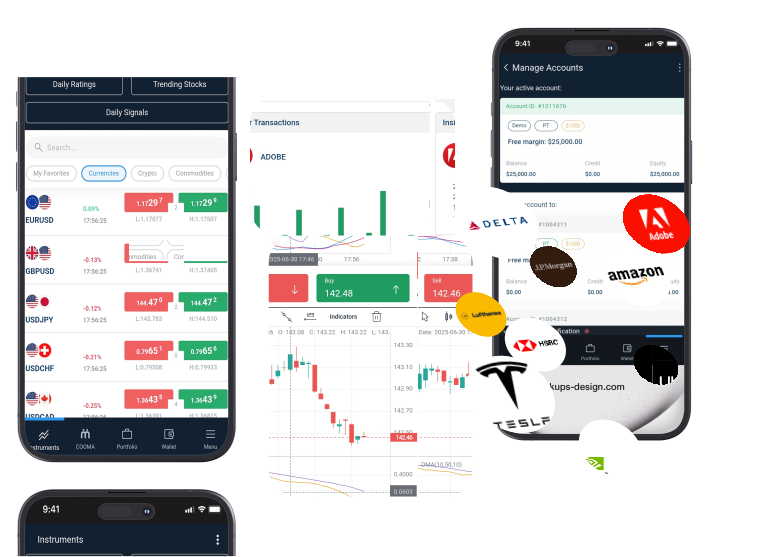
Mastering single candlestick patterns requires a trading environment that presents clean, clear price action with professional-grade charting tools that make pattern identification precise and effortless. AFAQ Trade delivers exactly this environment for serious price action traders across the Gulf region and beyond.
AFAQ Trade’s Web Trader platform and mobile app feature full candlestick charting across all available markets and timeframes — clean, customizable charts that present price action without visual clutter, giving you the clarity that precise candlestick analysis demands. Whether you’re scanning the daily chart of gold for hammer formations at key support, monitoring EUR/USD on H4 for shooting stars at resistance, or watching a Marubozu breakout develop on an equity index, the platform’s charting environment supports every level of candlestick analysis with professional precision.
FAQs
How reliable are single candlestick patterns as standalone trading signals?
Single candlestick patterns are most accurately described as high-quality contextual signals rather than standalone trading systems. Used in isolation, without consideration of the broader trend, key technical levels, volume confirmation, and timeframe context, individual candlestick patterns have only modest predictive reliability — any single candle shape can appear by chance in the middle of a range and produce no meaningful signal.
What is the difference between a hammer and an inverted hammer, and do they signal the same thing?
The hammer and inverted hammer are both bullish reversal signals that appear after downtrends. Still, their visual structure is entirely different, and they communicate their bullish message through different psychological mechanisms. The hammer has a long lower wick and a small body at the top of its range — it tells the story of sellers driving price down aggressively before buyers completely reclaimed the losses, closing near the high.
How should I use the doji pattern most effectively in live trading?
The doji is most effectively used as a timing signal within an established analytical framework rather than as a primary trade trigger. The ideal doji trading approach begins with identifying the broader context independently — trend direction, key support and resistance levels, momentum indicator readings — before the doji appears. When a doji then forms at a level you've already identified as significant, it provides the timing confirmation that the market has reached a point of equilibrium at your key level, suggesting a directional resolution is imminent.
Why does the Marubozu carry a stronger signal weight than other candlestick patterns?
The Marubozu's exceptional signal strength derives from what its complete absence of wicks reveals about the period's price action — one side completely dominated from the first moment of the period to the last without encountering meaningful resistance or support at any point. In every other significant candlestick pattern, wicks tell the story of one side initially gaining territory before the other side fought back — the hammer shows sellers initially winning before buyers reclaimed; the shooting star shows buyers initially winning before sellers took over.
Which single candlestick patterns work best in trending markets versus ranging markets?
The most effective single candlestick patterns in trending markets are those that identify pullback completion and trend continuation entry points — specifically the hammer (in uptrends, signaling the end of a retracement and the resumption of bullish momentum) and its bearish counterpart, the shooting star (in downtrends, signaling the end of a counter-trend bounce).