Cross Currency Pairs: What They Are and How To Trade Them?
In the vast and liquid world of foreign exchange, most retail traders begin — and many remain — firmly focused on a narrow band of dollar-dominated pairs. Yet the forex market is far richer, more nuanced, and full of opportunity beyond what the USD column shows. Understanding cross currency pairs opens an entirely new dimension of trading opportunity — one that professional traders and institutions have exploited for decades while the majority of retail participants remain unaware of their full strategic potential. This complete guide covers everything you need to know about cross pairs, how they work, why they matter, and how to trade them with precision and confidence.
What Are Cross Currency Pairs?
Before diving into strategy and application, establishing a precise, unambiguous definition of cross currency pairs — and what distinguishes them from other forex instruments — is the essential starting point.
A cross currency pair is any forex pair that does not include the US Dollar (USD) as either its base currency or its quote currency. Unlike the major pairs — EUR/USD, GBP/USD, USD/JPY — where every transaction involves the dollar on one side, cross pairs are formed by the direct exchange rate between two non-dollar currencies. EUR/GBP, EUR/JPY, GBP/JPY, AUD/NZD, and EUR/CHF are all classic examples of cross currency pairs.
Understanding cross pairs requires fluency with two foundational concepts that underpin every forex transaction:
- Base Currency: The first currency listed in a pair — in EUR/GBP, the euro is the base currency. The base currency is the one being bought or sold; its value is expressed in terms of the quote currency.
- Quote Currency: The second currency listed — in EUR/GBP, the British pound is the quote currency. The quote currency tells you how much of it is required to purchase one unit of the base currency.
The Forex Market Hierarchy: Majors, Minors, and Exotics
To fully appreciate cross currency pairs, it helps to understand the complete taxonomy of the forex market — how different pairs are classified and what that classification means for liquidity, spread costs, and trading dynamics.
Forex Majors
Forex majors are the seven most heavily traded currency pairs in the global forex market, all of which include the US Dollar as one half of the pair:
- EUR/USD — Euro / US Dollar
- GBP/USD — British Pound / US Dollar
- USD/JPY — US Dollar / Japanese Yen
- USD/CHF — US Dollar / Swiss Franc
- AUD/USD — Australian Dollar / US Dollar
- USD/CAD — US Dollar / Canadian Dollar
- NZD/USD — New Zealand Dollar / US Dollar
The majors account for the overwhelming majority of global forex volume, offering the tightest spreads, deepest liquidity, and most extensive analytical coverage of any forex instruments. They are the natural starting point for most retail traders and the core instruments of institutional forex desks worldwide.
Forex Minors
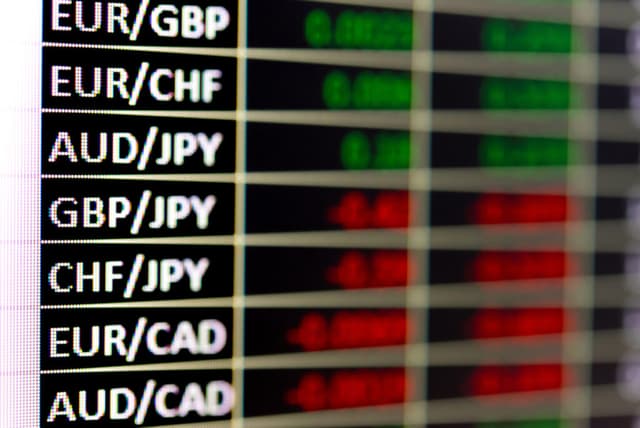
Forex minors — also called cross pairs — are pairs that combine two major non-dollar currencies directly, without USD involvement. They subdivide naturally into three families based on the euro, the British pound, and the Japanese yen:
Euro Crosses:
- EUR/GBP — Euro / British Pound
- EUR/JPY — Euro / Japanese Yen
- EUR/CHF — Euro / Swiss Franc
- EUR/AUD — Euro / Australian Dollar
- EUR/CAD — Euro / Canadian Dollar
- EUR/NZD — Euro / New Zealand Dollar
Sterling Crosses:
- GBP/JPY — British Pound / Japanese Yen
- GBP/CHF — British Pound / Swiss Franc
- GBP/AUD — British Pound / Australian Dollar
- GBP/CAD — British Pound / Canadian Dollar
- GBP/NZD — British Pound / New Zealand Dollar
Yen Crosses:
- AUD/JPY — Australian Dollar / Japanese Yen
- NZD/JPY — New Zealand Dollar / Japanese Yen
- CAD/JPY — Canadian Dollar / Japanese Yen
- CHF/JPY — Swiss Franc / Japanese Yen
Commodity Currency Crosses:
- AUD/NZD — Australian Dollar / New Zealand Dollar
- AUD/CAD — Australian Dollar / Canadian Dollar
- NZD/CAD — New Zealand Dollar / Canadian Dollar
Exotic Pairs
Exotic pairs combine one major currency with the currency of an emerging or smaller economy. Examples include USD/TRY (US Dollar / Turkish Lira), EUR/ZAR (Euro / South African Rand), GBP/SGD (British Pound / Singapore Dollar), and USD/MXN (US Dollar / Mexican Peso).
Exotic pairs typically feature significantly wider spreads, lower liquidity, higher volatility, and greater susceptibility to political and economic shocks than either major or minor pairs. They require specialized knowledge of the relevant emerging market economies, central bank behaviors, and geopolitical risk factors before trading.
How are cross-currency pair exchange rates calculated?
Understanding how cross currency pair exchange rates are derived from major pair rates is both intellectually important and practically useful — it allows traders to identify potential mispricings and understand the relationship between cross rates and their component major pairs.
The cross rate between two non-dollar currencies is derived by combining their respective rates against the US Dollar. The calculation method depends on whether the USD is the base or quote currency in each of the component major pairs.
Case 1 — Both currencies quoted against USD (e.g., EUR/JPY from EUR/USD and USD/JPY):
When EUR/USD = 1.0850 and USD/JPY = 149.50: EUR/JPY = EUR/USD × USD/JPY = 1.0850 × 149.50 = 162.19
Case 2 — One currency is base, one is quote (e.g., GBP/JPY from GBP/USD and USD/JPY):
When GBP/USD = 1.2650 and USD/JPY = 149.50: GBP/JPY = GBP/USD × USD/JPY = 1.2650 × 149.50 = 189.07
Case 3 — Both currencies are based against USD (e.g., AUD/NZD from AUD/USD and NZD/USD):
When AUD/USD = 0.6500 and NZD/USD = 0.5950: AUD/NZD = AUD/USD ÷ NZD/USD = 0.6500 ÷ 0.5950 = 1.0924
Understanding these derivations helps traders recognize when electronic cross rates deviate from their mathematically implied values. This condition creates triangular arbitrage opportunities that sophisticated traders and algorithms exploit to restore equilibrium.
Why Trade Cross Currency Pairs?
Many traders who understand cross pairs conceptually still default to major pairs out of habit or inertia. Understanding the concrete strategic advantages of cross-pair trading makes the case for expanding your forex universe compelling.
Advantage 1 — Purer Expression of Currency Views
When you have a specific view on the relative performance of two non-dollar currencies — say, you believe the Bank of England will be more hawkish than the European Central Bank — trading GBP/USD and EUR/USD separately exposes you to US Dollar risk on both sides. A move in the dollar against both currencies could dominate the trade outcome, regardless of your view on sterling vs euro being correct. Trading EUR/GBP directly expresses exactly the view you have without the confounding dollar influence.
Advantage 2 — Unique Volatility Profiles
Different cross pairs exhibit volatility characteristics that don’t exist in major pairs. GBP/JPY — nicknamed “the Dragon” by professional traders — is famous for its explosive intraday ranges, driven by the combination of sterling’s sensitivity to UK political and economic developments and the yen’s tendency toward sharp safe-haven flows. This volatility profile creates trading opportunities that don’t exist in quieter major pairs.
Advantage 3 — Reduced Correlation to the US Economic Calendar
Major pairs react violently to US economic data releases — NFP, CPI, FOMC decisions — creating unpredictable volatility that can stop out technically valid positions. Many cross pairs are far less sensitive to US data, allowing technical and fundamental setups to play out without being disrupted by American economic releases. EUR/CHF, for instance, moves primarily on European economic dynamics, ECB policy, and Swiss National Bank activity rather than US factors.
Advantage 4 — Portfolio Diversification
Building a forex portfolio across major and cross pairs — rather than concentrating entirely in dollar pairs — reduces correlation risk. When major pairs all move in the same direction due to a broad dollar trend, well-chosen cross-pair positions can provide diversifying returns that smooth overall portfolio volatility.
Advantage 5 — Unique Fundamental Drivers
Each cross pair is driven by its own distinct set of fundamental factors — the commodity dependence of AUD and NZD, the safe-haven properties of CHF and JPY, and the trade relationship between neighboring economies like AUD/NZD. Understanding these specific drivers allows traders to develop genuine fundamental edges that are impossible to build from dollar-centric analysis alone.
Key Cross Pairs Deep Dive: The Pairs Every Trader Should Know
EUR/GBP — The European Relationship
EUR/GBP measures the relative economic performance of the Eurozone against the United Kingdom — the world’s largest trading relationship outside of Asia. Key drivers include ECB vs Bank of England monetary policy divergence, UK economic data (GDP, inflation, employment), European economic sentiment indicators, and Brexit-related developments that continue to influence UK-EU trade dynamics. EUR/GBP is notable for its relatively tight trading range compared to other sterling crosses, reflecting the deep economic integration between the two economies.
EUR/JPY — The Risk Barometer
EUR/JPY is one of the most widely watched risk sentiment barometers in the professional forex community. The Japanese yen’s deep safe-haven characteristics mean EUR/JPY tends to rally during periods of global risk appetite and fall sharply during market stress events — making it a useful signal for broader market sentiment as well as a trading instrument in its own right.
GBP/JPY — The Dragon
GBP/JPY combines the volatility of sterling — one of the most reactive major currencies to domestic political and economic developments — with the yen’s safe-haven dynamics and Bank of Japan’s historically ultra-accommodative monetary policy. The result is a pair with some of the largest average daily ranges in the forex market, capable of multi-hundred pip moves within single trading sessions during periods of elevated volatility.
AUD/NZD — The Trans-Tasman Trade
AUD/NZD represents the exchange rate between two commodity-dependent economies with deep geographic and economic ties — Australia and New Zealand. Both economies are major exporters of agricultural commodities and raw materials. Still, their specific export mixes, central bank policies (Reserve Bank of Australia vs Reserve Bank of New Zealand), and domestic economic cycles create divergences that generate consistent trading opportunities for traders who understand both economies well.
EUR/CHF — The Safety Pair
EUR/CHF is heavily influenced by the Swiss National Bank’s interventionist history — the SNB famously maintained a EUR/CHF floor at 1.2000 for years before its dramatic removal in January 2015. This event caused one of the most violent single-day moves in forex history. Today, EUR/CHF remains heavily influenced by SNB policy, Eurozone economic health, and global risk sentiment that drives safe-haven flows into the Swiss franc.
Calculating Profit and Loss on Cross Pairs
Accurate profit and loss calculation is more complex for cross pairs than for major USD pairs, because the pip value must be converted through an additional step. Using a reliable profit calculator forex tool is essential for precise position sizing and risk management.
The Pip Value Calculation for Cross Pairs:
For a cross pair, the pip value is calculated by:
- Determining the pip value in the quote currency
- Converting that pip value to your account currency using the quote currency’s exchange rate against your account currency
Example — Calculating profit on EUR/GBP for a USD-denominated account:
- EUR/GBP position size: 100,000 (one standard lot)
- EUR/GBP moves from 0.8500 to 0.8550 (50 pips in your favor)
- Pip value in GBP: 0.0001 × 100,000 = £10 per pip
- Total gain in GBP: 50 × £10 = £500
- GBP/USD rate: 1.2650
- Total gain in USD: £500 × 1.2650 = $632.50
This additional conversion step is why position sizing on cross pairs requires either manual calculation or a dedicated profit calculator — using dollar-based pip value assumptions from major pair trading will produce inaccurate risk calculations that undermine proper trade management.
AFAQ Trade’s built-in pip and profit calculators handle these cross-currency conversions automatically, ensuring traders have accurate position sizing data before entering any cross-pair trade — a critical feature that removes one of the most common sources of error in cross-pair trading.
Technical Analysis on Cross Currency Pairs
One of the most common questions traders new to cross pairs ask is whether standard technical analysis approaches — support and resistance, trend following, order blocks, Smart Money Concepts — apply as reliably to crosses as they do to major pairs.
The answer is a clear yes, with some important nuances. Price action fundamentals are universal — market structure, institutional order flow, and human behavioral patterns that create recognizable chart formations operate across every liquid market, regardless of which currencies are involved.
Where cross pairs sometimes differ from majors:
- Spread sensitivity: Cross pairs typically carry wider spreads than major pairs, which makes scalping and very tight stop-loss strategies more expensive to execute profitably. Technical levels need to provide sufficient risk-to-reward headroom to absorb the wider spread cost.
- Session dependency: Some cross pairs are significantly more active during specific trading sessions. EUR crosses are most active during the European session (Frankfurt/London overlap). Yen crosses see their largest moves during the Asian session and the Tokyo/London overlap. Trading crosses during their “home session” typically offers tighter spreads and more decisive price action.
- Correlation awareness: Many cross-pairs share component currencies, creating natural correlations that need to be understood before building multi-pair positions. EUR/GBP and EUR/JPY both contain the euro — taking large positions in both simultaneously creates concentrated euro exposure that may not be immediately obvious.
Risk Management for Cross Currency Pair Trading
Effective risk management in cross-pair trading requires adapting general forex risk principles to the specific characteristics of these instruments.
- Position sizing with variable pip values: Because cross-pair pip values in account currency terms change as exchange rates fluctuate, position sizing must be recalculated rather than assumed constant. Even small changes in the component exchange rates can meaningfully shift pip values, particularly in volatile cross pairs like GBP/JPY.
- Correlation management: Building positions across multiple cross pairs requires careful attention to currency correlation. Holding simultaneous long EUR/GBP and long EUR/JPY positions means doubled euro long exposure — if the euro weakens broadly, both positions move against you simultaneously. Map your aggregate currency exposures, not just your individual pair positions.
- Session management: Trading cross pairs during their low-liquidity periods — particularly during the Asian-to-European session transition — can result in wide spreads and erratic price action that triggers stops unnecessarily. Plan cross-pair entries and management around the relevant session’s active hours.
- Event calendar awareness: Cross pairs respond to two separate domestic economic calendars rather than one. EUR/GBP traders need to monitor both the ECB announcement schedule and the Bank of England calendar. Missing either creates unnecessary surprise risk around high-impact events.
Finding the Best Forex Broker for Cross Currency Pair Trading
Selecting the best forex broker for cross-currency pair trading requires evaluating several criteria beyond the spreads and leverage ratios that most traders focus on first.
- Cross pair coverage breadth: Does the broker offer the full range of euro, sterling, yen, commodity, and emerging market crosses you want to trade — or only the most popular few?
- Spread quality on crosses: Spreads on cross pairs are inherently wider than major pairs. The differential in spread quality across brokers is larger for crosses than for majors, making broker selection more impactful for cross-pair traders.
- Session coverage: Cross pair trading requires active markets during European and Asian sessions, not just during US hours. Ensure your broker provides reliable execution during all relevant sessions.
- Calculation tools: Profit calculators, pip calculators, and margin calculators that handle cross-currency conversions accurately are essential — not a luxury — for cross-pair traders.
- Educational resources: The additional complexity of cross-pair trading — from pip value calculations to correlation management — makes educational support a genuinely valuable broker offering rather than a marketing feature.
AFAQ Trade delivers on every one of these dimensions. The platform offers comprehensive cross-pair access across all major currency families, professional-grade pip and profit calculators that handle cross-currency conversions automatically, tight competitive spreads across the full cross-pair universe, and a comprehensive trading academy that covers forex mechanics — from base currency and quote currency fundamentals all the way through advanced cross-pair strategy.
FAQs
Are cross currency pairs more difficult to trade than major pairs?
Cross-currency pairs carry additional complexity compared to major pairs, but are absolutely accessible to traders who invest time in understanding their specific characteristics. The primary areas of additional complexity involve pip value calculation (which requires an extra conversion step for USD-denominated accounts), spread costs (which are generally wider than major pairs), and the need to monitor two separate economic calendars rather than one.
What makes GBP/JPY so volatile compared to other cross pairs?
GBP/JPY's exceptional volatility — which regularly produces daily ranges of 150–300 pips compared to 60–100 pips for quieter crosses — results from the combination of two particularly reactive currencies.
How do I calculate the pip value for a cross currency pair?
Calculating pip value for cross-currency pairs requires a two-step process when your trading account is denominated in US dollars. First, calculate the pip value in the quote currency of the cross pair — for a standard lot (100,000 units), the pip value is simply 0.0001 multiplied by 100,000, which equals 10 units of the quote currency. Second, convert this amount to your account currency using the current exchange rate between the quote currency and your account currency.
Which cross currency pairs are best for traders focused on fundamental analysis?
The most fundamentally analyzable cross-pairs tend to be those where the driving factors are clear, well-documented, and relatively stable over time. EUR/GBP is particularly well-suited to fundamental analysis given its direct dependence on ECB vs Bank of England monetary policy divergence, UK-EU trade data, and the two economies' relative inflation and growth trajectories — all of which are extensively covered by financial media and accessible through standard economic calendars. AUD/NZD is excellent for commodity-focused fundamental traders, as both currencies are strongly influenced by iron ore, coal, and agricultural commodity prices alongside the divergent monetary policies of the Reserve Bank of Australia and Reserve Bank of New Zealand.
Can I hedge a major pair position using cross currency pairs?
Cross-currency pairs can absolutely be used as hedging instruments for major pair positions, though the mechanics require careful consideration of the correlations involved. If you hold a long EUR/USD position and want to hedge against euro weakness without closing the position, selling EUR/GBP (which would profit if the euro weakens against sterling) provides a partial hedge — but only against the euro component of your risk, not the dollar component.