How to Use Position Trading for Beginners?
Entering the world of trading can be overwhelming, especially for those new to financial markets. One approach that simplifies the process is position trading for beginners, which focuses on long-term trends rather than short-term fluctuations. This strategy allows traders to make decisions based on broader market movements and fundamental analysis. It also reduces the need for constant monitoring, making it ideal for those with limited time. By understanding the basics, beginners can build a solid foundation for consistent and disciplined trading.
What is position trading for beginners?
Position trading is a long-term investment approach designed for traders who prefer to hold assets for weeks, months, or even years rather than chasing short-term price fluctuations. Unlike day traders who close positions within minutes or hours, position traders focus on broader market trends and macroeconomic factors. This strategy is particularly well-suited for beginners who want to avoid the stress of constant market monitoring while still capitalizing on meaningful price movements.
The core principle of position trading for Beginners revolves around identifying high-probability trades based on fundamental analysis, technical patterns, and economic cycles not reacting to daily noise. Instead of predicting every minor price swing, position traders look for clear trends or structural shifts in the market. A position trader might buy a stock they believe is undervalued based on earnings reports and hold it for months until the market recognizes its true value. This approach demands discipline: resisting the temptation to take profits too early and staying calm through temporary pullbacks.
How Position Trading Works?
Position trading operates on three key pillars: market analysis, risk management, and patience.
Market Analysis
combines fundamental and technical approaches. Fundamental analysis involves examining economic indicators, company financials, industry trends, and geopolitical factors that could influence asset prices over the long term for instance, analyzing a company’s revenue growth, debt levels, and competitive positioning before taking a stock position. Technical analysis complements this by identifying trends, support and resistance levels, and chart patterns that signal optimal entry and exit points. Tools like moving averages, Bollinger Bands, and Fibonacci retracements help filter high-probability setups from background noise.
Risk Management
is equally critical. Position trading allows traders to allocate a meaningful portion of capital to each trade, but this makes disciplined risk management even more important, not less. Most position traders target a reward-to-risk ratio of at least 2:1 or 3:1 meaning if they risk 1% of their capital, the profit target should be at least twice that amount. Stop-loss orders are essential to cap downside; a common approach is setting a stop 5–10% below the entry price to protect against unexpected reversals without being triggered by normal market volatility.
Patience and Trade Execution
This is where many beginners struggle. Successful position traders wait for clear confirmation signals a breakout above a key resistance level, a sustained uptrend in momentum indicators, or a fundamental catalyst before entering. Once a position is open, the focus shifts to the bigger picture. Traders review their thesis periodically and adjust only when new information genuinely invalidates their original reasoning, not in response to short-term price fluctuations.
Indicators like RSI and MACD serve position traders well in this framework. A trader might wait for RSI to exit an overbought or oversold zone in alignment with a longer-term trend, or use MACD to confirm trend strength by waiting for the histogram to turn positive and sustain that direction for several weeks before committing capital.
Position Trading vs. Swing Trading: What’s the Difference?
While both strategies occupy the longer end of the trading spectrum, position trading and swing trading differ significantly in time horizon, tools, and execution style.
| Aspect | Position Trading | Swing Trading |
| Time Horizon | Weeks to months or even years | Days to a few weeks |
| Trading Goal | Capture major market moves driven by fundamentals | Capture short- to medium-term price swings |
| Analysis Type | Mainly fundamental + long-term technicals | Primarily short-term technical analysis |
| Tools Used | 200-day MA, Ichimoku, weekly/monthly volume trends | 50-day MA, stochastic, candlestick patterns |
| Market Focus | Ignores short-term noise | Focuses on intraday and short-term price action |
| Risk Management | Wider stop-loss (5–10%) due to volatility | Tighter stop-loss (1–3%) with active monitoring |
| Trade Frequency | Low (fewer trades) | Higher (more frequent trades) |
| Costs & Pressure | Lower costs and less emotional stress | Higher activity, more emotional pressure |
| Psychological Style | Requires patience and long-term conviction | Requires discipline and quick decision-making |
Why Choose Position Trading?
- Lower stress and emotional control are perhaps the most significant practical benefits. Position trading eliminates the need for split-second decisions or all-day screen time. Traders analyze markets during dedicated sessions and step away, avoiding the emotional toll of constant monitoring. The longer timeframe provides the perspective to weather short-term volatility without panic.
- Reduced transaction costs compound meaningfully over time. Fewer trades mean lower commissions, tighter effective spreads, and fewer instances of slippage. A position trader in forex might execute only a handful of trades per year a stark contrast to a day trader whose costs accumulate with every session.
- Alignment with fundamental analysis makes position trading particularly intuitive for traders with a background in finance, economics, or business. Rather than relying solely on technical patterns, position traders incorporate earnings data, economic cycles, and industry dynamics into their decisions producing more robust trade rationales theses that are grounded in real-world factors.
- Higher potential reward-to-risk ratios are accessible because position traders can afford wider targets. A well-researched position trade can return 20%, 50%, or more over its lifetime something rarely achievable in a single short-term trade. Entering a fundamentally sound stock at a discounted valuation and holding through recognition of that value can produce returns that dwarf what frequent traders capture through incremental gains.
- Compatibility with part-time trading makes position trading one of the few strategies genuinely available to people with full-time careers. Analysis can be conducted outside market hours, positions require only periodic review, and the strategy does not demand real-time presence during the trading day.
Position Trading Strategies
Position trading focuses on capturing long-term market trends by holding positions over extended periods. This approach relies on strong analysis and patience to benefit from major price movements while ignoring short-term fluctuations.
1. Trend Following
Trend following is built on the principle that markets move in sustained trends and that the most efficient path to profit is riding those trends to their natural conclusion. It is one of the most widely used position trading approaches across equities, commodities, and forex.
Traders identify trends using tools such as the 50-day and 200-day moving averages, trendlines, and the Average Directional Index (ADX). A strong trend is characterized by price remaining consistently above or below key moving averages with controlled pullbacks. Entry points are typically taken during pullbacks or consolidation phases within the trend waiting for the price to retrace to a moving average before entering long in an uptrend, for example.
Positions are held until the trend shows genuine exhaustion: a decisive break below a key support level, a bearish MACD crossover sustained over several weeks, or a significant deterioration in the ADX reading. Stop-losses are placed below recent swing lows for long positions, sized to reflect the asset’s normal volatility.
Trend following works well in strongly trending markets common in commodities during supply cycles, equities during economic expansions, and forex during divergent central bank policy periods. The primary challenge is performance in choppy, directionless markets, which is why ADX confirmation (a reading above 25) is valuable before entering.
2. Breakout Investing
Breakout investing focuses on entering trades when the price escapes a consolidation phase or breaks through a significant support or resistance level. The core logic is that once genuine momentum builds behind a breakout, it tends to continue in the direction of the break.
Traders look for assets that have been range-bound for weeks or months triangles, rectangles, flags, or horizontal channels. Breakout confirmation requires a daily close outside the range on meaningfully elevated volume; intraday wicks that reverse are dismissed. Entry is taken at or just beyond the breakout level, with the stop placed just inside the prior range to avoid being caught by normal volatility.
Profit targets are commonly projected using the height of the consolidation pattern. If a stock consolidates in a $10 range and breaks out above resistance, a $10 target extension above the breakout level is a reasonable first objective.
Common breakout patterns include horizontal range breaks, triangle breakouts (symmetrical, ascending, or descending), and flag and pennant continuations after strong initial moves. The most important discipline in this strategy is filtering out false breakouts requiring volume confirmation and a closing price decisively beyond the boundary reduces their frequency significantly.
3. Value-Based Positioning
Value-based positioning involves buying assets that appear undervalued relative to their intrinsic worth and holding until the market corrects the mispricing. This approach popularized by Warren Buffett and Benjamin Graham is deeply rooted in fundamental analysis and is characterized by patience measured in months or years, not days.
Traders use valuation metrics such as Price-to-Earnings (P/E), Price-to-Book (P/B), EV/EBITDA, and free cash flow yield to identify assets trading below fair value. The concept of a margin of safety buying at a significant discount to estimated intrinsic value provides a buffer against analytical error and continued downside before the market recognizes the value.
A practical example: a manufacturing company with a P/B ratio of 0.8 (trading below book value), a clean balance sheet, and solid fundamentals may be depressed due to temporary industry headwinds rather than structural problems. A value trader buys at the depressed price and waits for the catalyst improving industry conditions, an earnings recovery, or a strategic announcement that prompts revaluation.
The primary challenge is that undervalued assets can remain undervalued for longer than expected. Position sizing discipline and a clear thesis for what would trigger revaluation are essential to manage this risk.
4. Sector Rotation
Sector rotation involves systematically shifting investment exposure between economic sectors based on where the economy sits in its cycle. Different sectors predictably outperform at different stages of the economic cycle, and position traders who understand this dynamic can capture outsized returns by positioning ahead of transitions.
The general framework follows four phases. During economic expansion, consumer discretionary, technology, and financials typically lead. As growth peaks, energy and materials often outperform. In contraction and recession, defensive sectors utilities, healthcare, and consumer staples hold value better than cyclicals. During early recovery, industrials and financials tend to re-emerge as leaders.
Traders use macroeconomic indicators GDP growth trajectory, interest rate direction, inflation trends, and employment data to assess the current phase and position accordingly. Sector ETFs are the most practical instrument for this strategy, allowing clean, liquid exposure to entire sectors without the stock-specific risk of individual company selection.
5. Long-Term Thematic Investing
Thematic investing involves identifying multi-year structural trends technological shifts, demographic changes, policy transitions and building concentrated positions in assets that stand to benefit from those themes over a long horizon.
Current examples of investable themes include the global energy transition (renewable energy, battery storage, electric vehicles), artificial intelligence infrastructure, aging population demographics (healthcare, pharmaceuticals, elder care), and deglobalization (domestic manufacturing, supply chain reshoring). Themes of this nature can drive sustained outperformance over 5–10 year periods, providing position traders with a durable directional tailwind.
The key discipline in thematic investing is distinguishing between genuine structural trends and speculative hype cycles. Fundamental analysis of the underlying economics actual revenue growth, total addressable market, regulatory environment combined with valuation discipline, prevents overpaying for themes that are already fully priced into the market.
Advantages of Position Trading
- Lower transaction costs due to fewer trades.
- More sustainable time commitment with less need for constant monitoring.
- Relies on fundamental analysis, which is often more intuitive.
- Ability to capture larger profits from long-term trends.
- Reduced emotional stress compared to short-term trading styles.
Disadvantages of Position Trading
- Capital is tied up for long periods, reducing flexibility.
- Exposure to overnight and weekend risks (unexpected market events).
- Requires tolerance for drawdowns during the holding period.
- Slower feedback loop, making mistakes harder to detect early.
- Strong reliance on fundamental understanding to avoid holding losing positions too long.
Key Factors for Position Trading
Position trading success depends on more than just choosing the right strategy; it requires a strong foundation of practical and analytical elements. Traders must consider factors that impact long-term performance, from broker conditions to overall market awareness. These elements help ensure stability, reduce hidden risks, and support better decision-making over extended holding periods.
Key Elements for Successful Position Trading:
- Choosing a reliable broker with favorable swap rates and execution quality.
- Ensuring sufficient capital to handle drawdowns without forced exits.
- Understanding macroeconomic factors like interest rates and global events.
- Maintaining a detailed trading journal to track decisions and performance.
- Monitoring portfolio correlations to avoid hidden concentration risk.
How to Start Position Trading with AFAQ Trade?
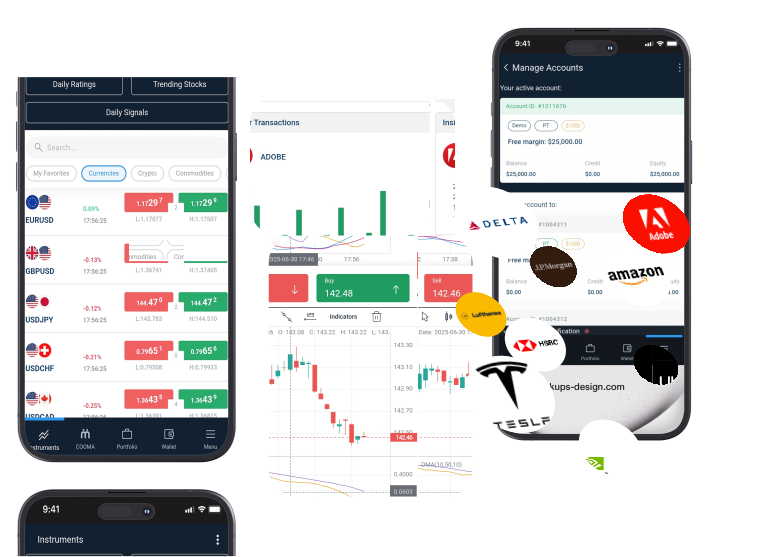
AFAQ Trade provides the infrastructure and analytical tools that position trading requires. The platform offers access to a broad range of instruments across equities, forex, and commodities, enabling traders to implement any of the strategies outlined above within a single environment. Real-time and historical charting tools support the technical analysis component of position trade selection, while fundamental data integration supports valuation-based approaches.
For beginners starting their position trading journey on AFAQ Trade, the recommended sequence is straightforward: begin by selecting one strategy trend following or value-based positioning are the most accessible for new position traders and apply it consistently to a small number of instruments. Use the platform’s risk management tools to define stop-loss levels and position sizes before entry, not after. Review open positions weekly rather than daily to avoid the impulse to react to short-term noise. As the strategy demonstrates consistency, positions and instrument diversity can be expanded gradually. The combination of a disciplined strategy and a reliable execution platform is the foundation upon which sustainable position trading performance is built.
FAQs
What tools are needed for position trading?
Position trading requires a relatively lean toolkit compared to shorter-term strategies. On the technical side, charting software with access to daily, weekly, and monthly timeframes is essential the 50-day and 200-day moving averages, MACD, RSI, and ADX cover most analytical needs. On the fundamental side, access to earnings reports, economic calendars, and sector data helps build and validate trade theses.
What are the risks of position trading for beginners?
The primary risks for beginners are holding losing positions too long due to emotional attachment to a thesis, insufficient capital to survive drawdowns without being forced out at the worst moment, and underestimating the impact of overnight and weekend gap risk on leveraged positions. Beginners also frequently fail to account for the cost of carry swap rates or financing costs on positions held for extended periods, which can meaningfully erode returns on longer-duration trades.
How can beginners manage risk effectively?
Effective risk management for position traders starts with position sizing. Never risk more than 1–2% of total account capital on any single trade, regardless of conviction level. Stop losses must be defined before entry and placed at technically meaningful levels (below key support for longs, above key resistance for shorts) rather than arbitrary percentages.