Stock Code Definition and Role in Stock Trading
In the vast and complex world of financial markets, information is power — and precision is essential. Traders, investors, and analysts depend on tools that simplify the way they identify, track, and trade companies across global exchanges. One such tool is the stock code, a unique identifier used worldwide to distinguish one publicly listed company from another.
A stock code is more than just a random set of letters — it is a universal shorthand for a company’s shares, recognized across trading terminals, financial news outlets, and stock market databases.
What is a Stock Code?
A stock code is a unique identifier assigned to a company’s shares on a stock exchange. It helps investors and traders quickly recognize and track the stock in financial markets.
Explanation of Stock Codes and Ticker Symbols
A stock code is a short series of letters or numbers used to identify a company’s publicly traded shares on a stock exchange. In the US, these codes are often called “ticker symbols.” For example, Apple Inc. trades under the stock code AAPL, while Tesla Inc. trades under TSLA.
These stock codes are not chosen arbitrarily. Stock exchanges carefully assign them to ensure that each listed company has a unique identifier. A stock code provides investors with a quick way to locate a company’s stock data, price charts, and performance information on financial websites or trading platforms.
In simpler terms, if a company’s full name is its identity, the stock code is its digital fingerprint — unique, standardized, and instantly recognizable. Understanding this system is essential for investors who rely on speed and precision in today’s fast-paced markets.
How Are They Assigned to Listed Companies?
Stock codes are assigned when a company goes public — that is, when it lists its shares on a stock exchange through an initial public offering (IPO). Exchanges have their own naming conventions and rules for assigning stock codes.
For example:
- The New York Stock Exchange (NYSE) typically uses up to three-letter stock codes (e.g., IBM for International Business Machines).
- The NASDAQ allows up to four or five-letter codes (e.g., AAPL for Apple, TSLA for Tesla).
- In other global markets, such as Japan or Hong Kong, stock codes can include numbers and suffixes (e.g., 7203.T for Toyota, 9988.HK for Alibaba).
Each exchange ensures that no two companies share the same stock code, preventing confusion among traders and investors. These codes also reflect listing categories, such as preferred shares, warrants, or ETFs.
Importance of Stock Codes in Financial Markets
The importance of stock codes cannot be overstated. In a world where thousands of companies are traded daily, having a standardized system of identification is crucial for transparency and efficiency.
Without stock codes, investors might easily confuse similar company names — especially in markets where firms operate under subsidiaries or have common naming conventions. For example, there are multiple companies with “Global Holdings” or “Tech Group” in their titles, but their stock codes clearly separate them.
Furthermore, stock codes make trading across international markets easier. Traders can instantly identify assets, reducing the risk of human error. Financial databases and automated systems also rely heavily on stock codes to retrieve data, execute trades, and process financial transactions in milliseconds.
Therefore, whether you are using a online trading platform, reading market news, or studying performance charts, the stock code serves as your essential reference point — a key to navigating global financial systems effectively.
Purpose of Stock Codes
Stock codes serve to uniquely identify and differentiate companies’ shares on exchanges. They simplify trading, tracking, and referencing stocks for investors and market participants.
Simplifying Trading and Identification
The primary purpose of a stock code is to simplify the trading process. By providing a universal shorthand, stock codes enable traders to execute buy or sell orders quickly without confusion.
When you log into your brokerage account or trading platform, typing “AAPL” instantly pulls up Apple’s stock chart, order book, and financial news. You don’t need to type the full company name or search manually — the stock code does the work for you.
This efficiency becomes even more important when executing high-frequency trades or monitoring large portfolios. A single mistyped name could lead to a costly error, but a standardized stock code eliminates such risks.
Distinguishing Between Companies with Similar Names
Another critical function of stock codes is distinguishing between companies with similar names. For example:
- “ABC Holdings” in one country may not be the same as “ABC Technologies” in another.
- In global markets, many companies use overlapping brand names.
The stock code ensures there’s no confusion. Each company gets a distinct code — regardless of name similarities — making the system precise and globally consistent.
For investors, this precision ensures accuracy in research, portfolio management, and performance tracking. The stock code’s meaning thus extends beyond convenience — it represents accuracy, reliability, and professionalism in the trading environment.
Examples of Stock Codes
Examples of stock codes illustrate how companies are listed and recognized on various exchanges. They help investors easily identify and trade specific stocks.
US Examples: AAPL (Apple), TSLA (Tesla), MSFT (Microsoft)
The United States, home to the world’s largest equity markets, provides many iconic examples of stock codes.
- AAPL: Represents Apple Inc., one of the most traded stocks globally.
- TSLA: Refers to Tesla Inc., known for its innovation in electric vehicles and energy.
- MSFT: The stock code for Microsoft Corporation, a global leader in software and cloud computing.
These simple codes are recognized by traders worldwide, demonstrating how the stock code serves as both a trading identifier and a symbol of brand identity.
International Examples: 9988.HK (Alibaba), 7203.T (Toyota)
In other regions, stock codes often include numerical or suffix-based identifiers.
- 9988.HK represents Alibaba Group on the Hong Kong Stock Exchange.
- 7203.T represents Toyota Motor Corporation on the Tokyo Stock Exchange.
These examples highlight how global exchanges use unique conventions — letters for US exchanges and numbers or extensions for others. The stock codes list varies from market to market, but the concept remains universally consistent: unique identification for efficient trading.
How Do Stock Codes Differ by Exchange?
Stock codes differ by exchange based on listing rules, formatting, and regional conventions. Each exchange assigns unique identifiers to ensure clarity and prevent confusion among traded stocks.
NYSE, NASDAQ, London Stock Exchange, Tokyo Stock Exchange
Each exchange follows its own format when assigning stock codes:
- NYSE (New York Stock Exchange): Primarily uses up to three letters, such as IBM or KO (Coca-Cola).
- NASDAQ: Typically employs four or five-letter stock codes, like AAPL (Apple) or AMZN (Amazon).
- London Stock Exchange (LSE): Uses alphanumeric codes such as HSBA for HSBC Holdings.
- Tokyo Stock Exchange (TSE): Uses numeric codes like 7203 for Toyota or 6758 for Sony.
These differences allow each exchange to maintain clarity within its systems while still adhering to the universal stock code definition.
Regional Variations and Suffix Conventions
Suffixes in stock codes often indicate additional information, such as exchange location or share type. For example:
- “.HK” for Hong Kong
- “T” for Tokyo
- “L” for London
A company like HSBC may have multiple listings, each with a slightly different code to indicate where it’s traded. For example, HSBC’s code in London differs from its code in Hong Kong.
Understanding these suffixes helps investors interpret international stock listings and ensures accuracy when performing a stock code search on global platforms.
How to Find a Company’s Stock Code?
Finding a company’s stock code is straightforward. Most financial platforms, trading websites, and investment research portals provide searchable databases.
Here are some reliable methods:
- Search on financial news platforms like Yahoo Finance, MarketWatch, or Bloomberg. Type the company name to retrieve its stock code and related data.
- Check on the company’s investor relations page. Publicly listed companies always publish their trading codes and exchange details.
- Use trading platforms or mobile apps like MetaTrader, Evest, or AFAQ’s trading interface — all provide instant stock code search functions.
- Consult exchange websites directly (e.g., NASDAQ.com, HKEX.com, or TSE.co.jp).
Additionally, tools like Google Finance allow quick lookups. For instance, typing “stock code for Google” yields GOOG or GOOGL, representing different share classes of Alphabet Inc.
Having access to a comprehensive stock code list makes market research faster and ensures you’re monitoring the correct assets.
Why Stock Codes Matter for Investors?
Stock codes matter for investors because they provide a clear and standardized way to identify and trade shares. They simplify market tracking, research, and portfolio management.
Quick Access to Company Data
The stock code serves as an instant gateway to critical company information. By entering a stock code on trading platforms, investors can access charts, financial reports, dividends, and price movements within seconds.
This efficiency supports decision-making in high-paced markets where every second counts. Traders and analysts rely on the precision of stock codes to track performance and make accurate comparisons across industries.
Avoiding Confusion During Trading
Imagine two companies with nearly identical names. Without stock codes, a trader might mistakenly buy the wrong stock — a costly error. The stock code eliminates this risk. It offers a clear, one-to-one mapping between the company and its shares, protecting investors from unnecessary losses.
Importance of Automated Trading Systems
In algorithmic or automated trading, computers rely entirely on numerical or coded identifiers rather than company names. The stock code ensures that systems execute trades precisely and without ambiguity.
Every time a trade is executed electronically, it references the stock code — making it one of the most essential elements of the digital financial ecosystem.
How to Use Stock Codes in Trading Platforms?
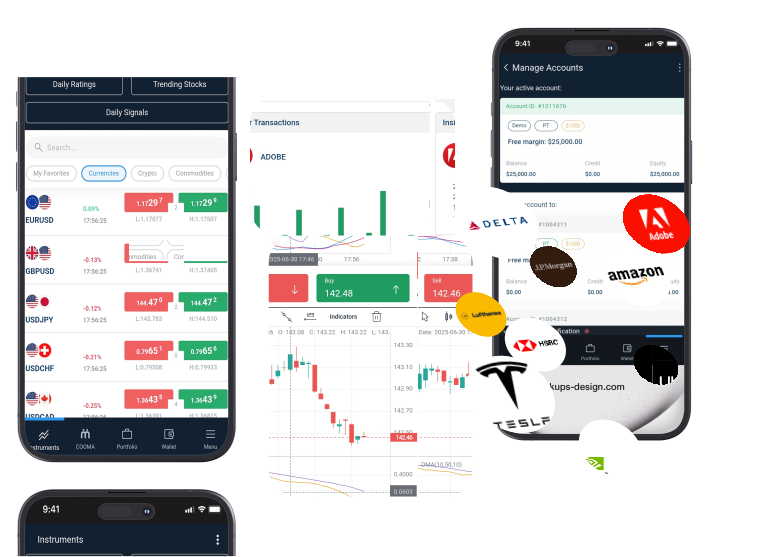
Online Trading platforms like AFAQ make using stock codes effortless. When you open an account, you can search for any company’s stock code and instantly view its market data.
Here’s how to use them effectively:
- Searching: Enter the code directly (e.g., AAPL, TSLA, or 9988.HK).
- Placing Orders: Use the code to specify the exact stock you want to buy or sell.
- Tracking Performance: Add stock codes to your watchlist to monitor price changes in real time.
- Technical Analysis: Use the stock code to generate price charts, graphs, and performance analytics.
Whether you’re an active trader or a long-term investor, mastering the use of stock codes ensures accuracy, saves time, and enhances portfolio management efficiency.
Services Of Afaq
AFAQ Trade is an electronic platform specializing in trading Contracts for Difference (CFDs), with a primary focus on the Gulf markets.
The platform aims to provide a simple, secure, and professional trading experience through platforms such as WebTrader and Mobile App, supported by educational tools like webinars, an academy, demo accounts, and a copy-trading feature.
Licenses and Legal Entity
The platform is owned by Afaq FX Markets (Comoros) LTD, registered in the Comoros.
It is licensed by the MWALI International Services Authority under license number BFX2025079, adding a layer of transparency and reliability for investors.
Key Services
- Trading in forex, stocks, commodities, and indices.
- Islamic accounts are compliant with Sharia.
- Demo account with $25,000 virtual funds for training.
- Advanced analysis tools, live customer support, and competitive trading fees (low spreads).
- Secure deposit and withdrawal procedures.
Account Types
- Basic – Minimum deposit up to $4,999.
- Advanced – From $5,000 to $19,999.
- Premium – $20,000 and above with advanced features.
- Sharia Account – Sharia-compliant, swap-free, with Sharia fees applied after the 4th day.
- Demo – Realistic trading experience with no financial risk.
In Conclusion
The stock code is the backbone of modern financial trading systems — simple yet powerful. It standardizes global equity markets, ensuring that investors, institutions, and trading algorithms can interact seamlessly.
Understanding the stock code meaning, learning how to perform a stock code search, and knowing how to interpret regional differences are all essential for effective market participation. Whether you are analyzing the stock code for Google or browsing through a stock codes list, these identifiers provide structure and reliability to the global financial system.
At AFAQ, we help traders and investors navigate the financial world confidently, providing insights, education, and technology-driven tools to simplify every trading experience.
FAQs
How to find the stock code?
You can find a company's stock code by searching on financial websites like Yahoo Finance, Bloomberg, or Google Finance. You can also use trading platforms such as AFAQ to locate accurate and up-to-date stock codes instantly.
What is meant by stock code?
A stock code is a unique identifier used to represent a company's shares on a stock exchange. It simplifies trading, ensures accuracy, and helps investors quickly access company information.
What is the 7% rule in stocks?
The 7% rule is a common risk management strategy suggesting that investors should sell a stock if it falls more than 7% below the purchase price to limit potential losses.