SSE Composite Index Latest Value and Market Update
In the global financial landscape, few indicators reflect the pulse of China’s economy as powerfully as the SSE Composite Index. Representing the performance of all stocks listed on the Shanghai Stock Exchange, this index is not only a mirror of domestic economic activity but also a critical benchmark for investors tracking Asia’s largest emerging market.
Over the last decade, China has rapidly transformed into one of the world’s largest economies. The SSE Composite Index serves as a barometer of that transformation — capturing the rise of state-owned enterprises, the growth of private sector innovation, and the influence of foreign investment. The performance of this index often sets the tone for market sentiment in Asia and influences investment decisions globally.
What is the SSE Composite Index?
The SSE Composite Index (Shanghai Stock Exchange Composite Index) is a stock trading markets index that tracks the performance of all shares listed on the Shanghai Stock Exchange (SSE). It includes both A-shares, which are traded in Chinese yuan and available primarily to domestic investors, and B-shares, which are traded in U.S. dollars and accessible to foreign investors.
Introduced on July 15, 1991, the index was designed to provide a comprehensive representation of the entire Shanghai Stock Exchange composite market. It’s a crucial measure of China’s economic health, capturing companies across various sectors such as finance, manufacturing, energy, technology, and consumer goods.
The Shanghai Stock Exchange index acts as a benchmark for mutual funds, ETFs, and institutional investors who seek exposure to the Chinese market. It reflects investor sentiment toward Chinese economic growth, corporate earnings, and fiscal policy, making it a key indicator of the nation’s financial trajectory.
At its core, the SSE Composite Index provides insight into China’s evolving economic landscape — highlighting the balance between traditional industries and new technology-driven enterprises that define modern Chinese capitalism.
Importance of the Index in Global Financial Markets
The SSE Composite Index plays a vital role in connecting China’s domestic economy to the global financial system. As the world’s second-largest economy, China’s market movements influence trade balances, supply chains, and investment flows around the world.
For international investors, the Shanghai Stock Exchange composite index represents an essential benchmark for understanding Chinese market trends. Global funds, hedge funds, and institutional investors monitor its daily performance to gauge risk appetite in emerging markets.
Moreover, fluctuations in the SSE Composite Index can have ripple effects on global equities. A sharp rise may boost confidence in Asia’s economic resilience, while a decline can spark caution in foreign markets, particularly those heavily reliant on Chinese demand.
In essence, this index is not just a local financial measure — it is a reflection of global interdependence. Its behaviour often correlates with commodity markets, particularly metals and energy, as China remains a major consumer of global resources.
As AFAQ highlights in its market insights, the SSE Composite Index serves as a leading indicator for both regional and international investors, shaping decisions that influence portfolios across continents.
The Shanghai Stock Exchange and Its Role in China’s Economy
The Shanghai Stock Exchange (SSE) is the cornerstone of China’s financial system. Established in 1990, it quickly grew into one of the largest stock exchanges in the world by market capitalization. It lists thousands of companies, from state-owned giants to rapidly growing private firms, representing the backbone of China’s industrial and technological progress.
The Shanghai stock composite index tracks the overall performance of these companies, offering a snapshot of China’s business environment and economic stability. It acts as both a fundraising platform for corporations and a wealth-building mechanism for millions of investors.
Furthermore, the SSE plays a crucial role in capital allocation — directing savings from households into productive investments. Its movements, reflected through the SSE Composite Index, signal economic confidence and guide government policy adjustments.
As China continues to expand its financial reforms, the Shanghai Stock Exchange remains central to its integration with the global economy, especially through programs like Stock Connect that link it with other major exchanges.
Composition of the SSE Composite Index
The SSE Composite Index includes every stock traded on the Shanghai Stock Exchange, making it one of the most inclusive indices in the world. Its composition spans across numerous sectors, capturing the diversity of China’s economy.
Types of Companies Included
The index covers large-cap state-owned enterprises (SOEs) such as PetroChina, ICBC, and Sinopec, as well as fast-growing private firms in technology and healthcare. It also includes industrials, energy producers, financial institutions, and real estate developers.
This broad inclusion ensures that the Shanghai stock exchange composite accurately reflects the performance of both traditional and emerging sectors. By tracking such a wide range of industries, analysts can use the SSE Composite Index chart to assess economic cycles and identify sector-specific growth trends.
How is the SSE Composite Index Calculated?
The SSE Composite Index is a market capitalization-weighted index. This means that companies with larger market capitalizations have a greater impact on the index’s overall movement.
Formula and Methodology
The calculation formula is as follows:
Index = (Current Total Market Value / Base Period Total Market Value) × 100
The base period for the SSE Composite Index was set at 100 points on December 19, 1990. Since then, it has grown significantly, fluctuating with China’s economic expansion, stock market reforms, and investor sentiment.
Price-Weighted vs. Market Capitalization-Weighted Approach
Unlike price-weighted indices (such as the Dow Jones Industrial Average), the Shanghai SE Composite Index chart gives more weight to companies with larger market capitalization rather than higher stock prices. This ensures that the index reflects real economic size and performance rather than just price movements.
This methodology makes the SSE Composite Index an accurate representation of China’s corporate landscape and economic power.
Historical Performance Overview
Since its inception, the SSE Composite Index has experienced several significant phases of growth and correction. In the early 2000s, the index reflected China’s rapid industrialisation and entry into the World Trade Organisation (WTO).
The most notable rally occurred between 2005 and 2007 when the Shanghai stock exchange composite index soared as domestic and foreign investors poured capital into Chinese equities. However, this was followed by a sharp correction during the 2008 global financial crisis.
Another significant rise came in 2014–2015, driven by speculative trading and margin finance, which again resulted in a major correction. Since then, the market has stabilized, driven more by fundamentals than speculation.
Through its fluctuations, the SSE Composite Index has mirrored the evolution of China’s economy — shifting from manufacturing-led growth to technology, innovation, and domestic consumption.
Factors Influencing the SSE Composite Index
Several factors shape the performance of the SSE Composite Index, including domestic economic data, government policy, and international developments.
Economic Indicators in China
GDP growth, industrial output, retail sales, and fixed-asset investment are key indicators that impact the index. A rise in these metrics typically drives investor confidence, boosting the SSE Composite Index.
Monetary Policy and Government Regulations
The People’s Bank of China’s interest rate policies, liquidity injections, and fiscal measures directly affect market liquidity and stock valuations. Regulatory reforms, particularly around capital markets, also influence investor sentiment.
Global Market Influences
Because China’s economy is deeply integrated with global trade, external factors such as U.S. monetary policy, geopolitical tensions, and global commodity prices play major roles. A stronger dollar, for example, often pressures emerging markets, while favourable trade agreements can boost the SSE Composite Index.
SSE Composite Index vs Other Major Indices
The SSE Composite Index is often compared with other regional and global benchmarks to gauge relative market performance.
Comparison with Hang Seng, Nikkei 225, and S&P 500
While the Hang Seng Index reflects Hong Kong’s open market, and the Nikkei 225 tracks Japan’s industrial and technology leaders, the Shanghai stock exchange index focuses more on mainland China’s economy. The S&P 500, in contrast, represents the U.S. market — heavily driven by technology and corporate profits.
Differences in Market Focus and Volatility
The SSE Composite Index tends to be more sensitive to government policy and macroeconomic data, while developed market indices are influenced by corporate earnings and monetary policy. This unique characteristic creates both opportunities and challenges for global investors seeking diversification.
How Investors Use the SSE Composite Index
Investors use the SSE Composite Index as a benchmark for performance comparison and risk management. It serves as a foundation for financial instruments like ETFs, futures, and index funds that track China’s stock market.
For foreign investors, the index offers an accessible way to gain exposure to China’s economy without purchasing individual stocks. It also helps analysts forecast economic trends and investment cycles.
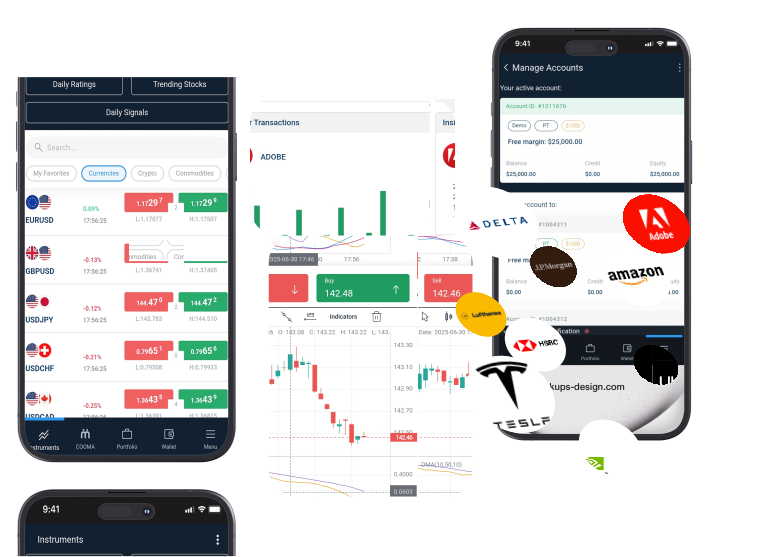
On platforms like AFAQ, investors can explore real-time SSE Composite Index chart data, study historical movements, and integrate this information into global trading strategies.
Services Of Afaq
AFAQ Trade is an electronic platform specializing in trading Contracts for Difference (CFDs), with a primary focus on the Gulf markets.
The platform aims to provide a simple, secure, and professional trading experience through platforms such as WebTrader and Mobile App, supported by educational tools like webinars, an academy, demo accounts, and a copy-trading feature.
Licenses and Legal Entity
The platform is owned by Afaq FX Markets (Comoros) LTD, registered in the Comoros.
It is licensed by the MWALI International Services Authority under license number BFX2025079, adding a layer of transparency and reliability for investors.
Key Services
- Trading in forex, stocks, commodities, and indices.
- Islamic accounts are compliant with Sharia.
- Demo account with $25,000 virtual funds for training.
- Advanced analysis tools, live customer support, and competitive trading fees (low spreads).
- Secure deposit and withdrawal procedures.
Account Types
- Basic – Minimum deposit up to $4,999.
- Advanced – From $5,000 to $19,999.
- Premium – $20,000 and above with advanced features.
- Sharia Account – Sharia-compliant, swap-free, with Sharia fees applied after the 4th day.
- Demo – Realistic trading experience with no financial risk.
In Conclusion
The SSE Composite Index is more than just a measure of stock prices — it’s a reflection of China’s economic ambition, policy direction, and industrial progress. As one of the world’s most influential benchmarks, it plays a pivotal role in global market analysis.
By tracking the Shanghai stock exchange composite index, investors gain valuable insights into one of the most dynamic economies on the planet. Whether for long-term portfolio diversification or short-term trading, understanding this index is essential for anyone engaging in global finance.
For the latest market data, live updates, and professional analysis on the SSE Composite Index, visit AFAQ — your trusted platform for accurate market intelligence and trading signals.
FAQs
What is the SSE Composite Index?
The SSE Composite Index tracks all listed stocks on the Shanghai Stock Exchange, representing China's overall market performance and economic strength.
How to invest in the SSE Composite Index?
Investors can gain exposure through ETFs, mutual funds, or index futures linked to the Shanghai stock exchange composite.
Which is China's biggest stock exchange?
The Shanghai Stock Exchange is China's largest and one of the world's leading financial centres, home to the SSE Composite Index.