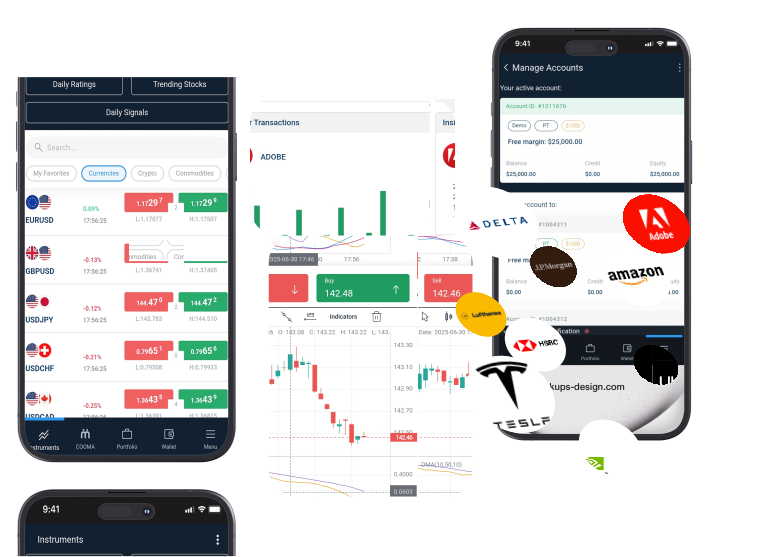
Is Scalping Trading Suitable for Fast Markets?
Scalping trading is a fast-paced strategy favored by active traders aiming to profit from small, frequent price movements. Unlike long-term investing, it focuses on short-term opportunities in highly liquid markets like forex, stocks, futures, and cryptocurrencies.
While attractive for its multiple daily chances, scalping demands precision, discipline, and specialized tools. AFAQ’s guide covers everything from scalping basics to strategies, risks, and comparisons with other trading styles like swing trading. It’s especially helpful for beginners exploring scalping in various markets, offering insights into indicators, execution, and how to build a successful approach tailored to individual trading goals.
Definition of Scalping Trading
Scalping trading is a high-frequency trading style focused on capturing small profits repeatedly from short-term price movements. Instead of holding positions for hours, days, or weeks, scalpers enter and exit trades within seconds or minutes. The aim is not to gain large profits in a single trade but to accumulate small gains consistently, which can add up significantly over time.
The scalping trading meaning emphasizes speed, accuracy, and risk control. Scalpers use leverage in many cases, which amplifies both potential profits and risks. Unlike investors who rely on long-term fundamentals, scalpers rely almost exclusively on technical analysis, market depth, and scalping trading indicators such as moving averages, Bollinger Bands, RSI, MACD, and volume-based tools.
One of the unique aspects of scalping trading is its reliance on liquidity. Traders prefer highly liquid markets where bid-ask spreads are tight and price movements are frequent, ensuring that they can enter and exit trades quickly without large slippage. Markets like forex, major stock indices, and gold futures often attract scalpers because they provide the liquidity and volatility necessary for success.
For scalping trading for beginners, the idea might initially seem overwhelming. The pace is fast, and mistakes can be costly. However, once a trader understands the basics, practices discipline, and adopts effective scalping trading strategies, this style can be an efficient way to generate profits in the short term.
How Does It Differ from Other Trading Styles?
To fully understand scalping, it’s essential to compare it with other trading styles. The main difference lies in timeframes and objectives.
- Swing Trading vs. Scalping Trading:
- Swing trading typically involves holding positions for several days or weeks to capture medium-term price movements. While swing traders may place only a handful of trades in a week, scalpers can execute dozens or even hundreds daily. Swing traders rely on broader technical patterns and sometimes fundamental factors, while scalpers focus on immediate micro-movements. Thus, scalping trading vs swing trading highlights two extremes: short-term rapid action versus medium-term patience.
- Day Trading vs. Scalping:
- Day trading involves opening and closing trades within the same day, but positions may last hours. Scalping, however, takes this to the next level by shortening the trade horizon to just minutes or seconds. Scalping requires faster execution and a greater number of trades compared to regular day trading.
- Position Trading vs. Scalping:
- Position traders hold assets for weeks, months, or years, aiming for long-term trends. In contrast, scalpers are uninterested in long-term outlooks; they only care about immediate opportunities.
Ultimately, scalping is more labor-intensive, requires constant market monitoring, and involves a higher transaction frequency compared to other trading styles. This makes it best suited for traders who thrive under pressure, enjoy analyzing rapid changes, and can maintain emotional discipline.
How Scalping Trading Works?
Scalping trading operates on rapid decision-making and swift execution to capitalize on short-term market fluctuations. It’s a technique designed for traders who thrive in fast-moving environments and seek frequent, small gains.
Small Price Movements and Quick Trades
Scalping trading works on the principle of profiting from small price movements. For example, a trader might buy a stock at $100.00 and sell it at $100.05. While this may seem insignificant, repeating such trades dozens of times in a day can generate meaningful profits. Scalpers often trade with high volume or leverage to make these small gains worthwhile.
Timeframes Commonly Used in Scalping
Scalping usually occurs on ultra-short timeframes such as the 1-minute, 5-minute, or tick charts. Traders rarely hold positions beyond 15 minutes. These shorter timeframes allow scalpers to spot micro-trends and capitalize on quick reversals. The chosen timeframe depends on the trader’s style, but speed remains critical.
Role of Liquidity and Volatility
Liquidity and volatility are the lifelines of scalping trading. Without liquidity, traders may face wide spreads and slippage, reducing profitability. Without volatility, there are fewer opportunities to exploit. Scalpers gravitate toward markets with a combination of both. For example, scalping trading forex is extremely popular because currency pairs like EUR/USD are highly liquid and volatile, making them perfect for quick trades. Similarly, scalping trading futures in indices and commodities offers enough liquidity and price movement to sustain this strategy.
5. Benefits of Scalping Trading
Quick Profits from Small Moves
The primary advantage of scalping trading is the ability to make quick profits. Instead of waiting for weeks for a stock to rise, scalpers can capitalize on small moves multiple times a day.
High Number of Trading Opportunities
Scalping provides numerous opportunities daily. Unlike swing trading, which may rely on only a few setups each week, scalping offers constant action. This suits traders who prefer an active, engaging approach to the markets.
Lower Exposure to Market Risk
Since scalpers hold positions for very short periods, they reduce exposure to overnight risks or unexpected news events. By closing positions quickly, scalpers limit their vulnerability to external shocks, a major advantage compared to longer-term traders.
Risks of Scalping Trading
While scalping can be profitable, it carries significant risks. Frequent trading leads to higher transaction costs, spreads, and commissions, which can erode profits. Emotional stress is another factor—scalpers must remain focused for long hours, reacting quickly to price movements. Leverage can amplify gains but also magnify losses.
Beginners often underestimate how discipline is essential in scalping trading. Without strict risk management, a few losing trades can wipe out the profits from dozens of successful ones.
Popular Scalping Trading Strategies
The Scalping Trading Strategy is a trading approach that focuses on making small, quick profits from tiny price changes and making a fast profit from reselling. Traders who use this strategy aim to profit from many small trades throughout the day. The Scalping Trading Strategy is popular among traders who prefer a high volume of trades for small gains instead of waiting for big moves in the market.
Moving Average Scalping
This involves using short-term moving averages to identify entry and exit points. For example, a 5-period moving average crossing above a 20-period average may signal a buy.
Bollinger Bands Scalping
Bollinger Bands help scalpers identify overbought and oversold conditions. When the price touches the lower band, it might present a buying opportunity, while touching the upper band signals potential selling.
Price Action Scalping
This strategy relies on analyzing candlestick patterns, support and resistance, and trendlines without relying heavily on indicators.
Order Flow and Volume-Based Scalping
By analyzing real-time order flow and trading volume, scalpers can anticipate short-term price movements more effectively. This requires advanced tools and experience, but can be highly effective.
Best Markets for Scalping Trading
The best markets to scalp are those with the most volatility and narrow trading ranges.
Forex Scalping
Scalping trading in forex is highly popular due to the liquidity of currency pairs like EUR/USD, GBP/USD, and USD/JPY. Spreads are tight, and volatility provides constant opportunities.
Stock Scalping
Stocks with high volume and liquidity, such as large-cap companies, are attractive for scalpers. Earnings announcements and news events also create volatility ideal for scalping.
Futures and Indices Scalping
Scalping trading futures in indices like the S&P 500 or commodities like crude oil provides liquidity and volatility.
Cryptocurrency Scalping
The crypto market is highly volatile, making it suitable for scalping. Pairs like BTC/USD or ETH/USD attract scalpers seeking rapid movements.
Tips for Successful Scalping Trading
- Use a reliable broker with low spreads and commissions.
- Stick to liquid markets for easier entries and exits.
- Employ risk management: set stop-loss orders and avoid overleveraging.
- Develop a clear scalping trading strategy and practice it on demo accounts before live trading.
- Use effective scalping trading indicators, but avoid overloading charts.
- Stay disciplined; avoid emotional trading decisions.
Services Of Afaq
AFAQ Trade is an electronic platform specializing in trading Contracts for Difference (CFDs), with a primary focus on the Gulf markets.
The platform aims to provide a simple, secure, and professional trading experience through platforms such as WebTrader and Mobile App, supported by educational tools like webinars, an academy, demo accounts, and a copy-trading feature.
Licenses and Legal Entity
The platform is owned by Afaq FX Markets (Comoros) LTD, registered in Comoros.
It is licensed by the MWALI International Services Authority under license number BFX2025079, adding a layer of transparency and reliability for investors.
Key Services
- Trading in forex, stocks, commodities, and indices.
- Islamic accounts are compliant with Sharia.
- Demo account with $25,000 virtual funds for training.
- Advanced analysis tools, live customer support, and competitive trading fees (low spreads).
- Secure deposit and withdrawal procedures.
Account Types
- Basic – Minimum deposit up to $4,999.
- Advanced – From $5,000 to $19,999.
- Premium – $20,000 and above with advanced features.
- Sharia Account – Sharia-compliant, swap-free, with Sharia fees applied after the 4th day.
- Demo – Realistic trading experience with no financial risk.
In Conclusion
Scalping trading is an exciting and fast-paced approach that offers traders the chance to generate consistent profits from small price movements. While it requires discipline, advanced tools, and focus, it can be highly rewarding when executed correctly. Whether exploring scalping trading futures, scalping trading options, or scalping trading forex, scalpers need to balance speed with risk management. For scalping trading for beginners, starting small, practicing strategies, and gradually building confidence is the best way forward.
AFAQ provides resources, insights, and market access to help traders refine their skills in scalping and other trading styles. By combining education with practice, traders can make scalping a sustainable part of their trading journey.
FAQs
Is scalping trading profitable?
Yes, scalping trading can be profitable if done correctly, with discipline and effective strategies. However, transaction costs and emotional pressure make it challenging.
What is scalping in trading?
Scalping in trading refers to capturing small profits from quick trades, often lasting seconds or minutes, repeated multiple times a day.
Is scalping good for beginners?
Scalping trading for beginners can be overwhelming due to speed and complexity, but with proper education and practice, beginners can gradually adapt to this style.
How do I start scalping?
To start scalping, choose a liquid market (like forex), open a trading account with a low-cost broker, practice strategies on demo accounts, and learn to use effective scalping trading indicators.