Can Risk Management Protect You From Major Losses?
In the fast-moving world of financial trading, success is not just about spotting opportunities—it’s about managing risk effectively. While profits attract traders to the markets, it’s Risk Management that ensures they stay there long enough to enjoy consistent gains. At AFAQ, we understand that every trader—whether novice or expert—must master the art and science of Risk Management to thrive in today’s volatile trading environment.
Trading inherently involves uncertainty. Markets fluctuate due to global events, economic data, investor sentiment, and countless other factors. Without a structured approach to managing risk, even a few bad trades can lead to significant losses. This is why Risk Management strategies are the cornerstone of long-term trading success.
This comprehensive guide by AFAQ explores everything traders need to know about Risk Management—from understanding its importance and principles to implementing professional techniques that reduce exposure and protect capital. You’ll also discover how tools, analytics, and diversification can help turn volatility into opportunity.
What is Risk Management in Trading?
Risk Management in trading refers to the systematic process of identifying, assessing, and controlling the potential losses that arise from market fluctuations. It’s about protecting your capital by minimizing exposure to adverse price movements while maximizing the potential for profitable trades.
In simple terms, Risk Management acts as a financial safety net. It involves setting rules that define how much of your trading capital you’re willing to risk on a single trade, where to place stop-loss orders, and how to diversify across markets.
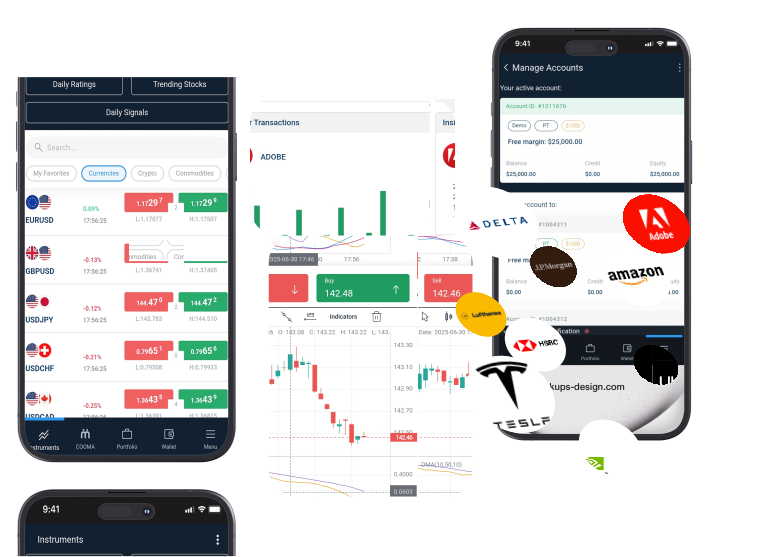
AFAQ’s advanced trading platform provides risk management solutions that help traders implement these principles seamlessly. Whether through automatic stop-loss tools, leverage control, or position sizing calculators, traders can trade confidently knowing that every decision aligns with a predefined risk management process.
Understanding What Is Risk Management? Means recognizing that it’s not about avoiding risk completely—it’s about controlling it intelligently. Every successful trader accepts that losses are inevitable but ensures they are manageable and proportionate to potential rewards.
Why is Risk Management Essential for Every Trader?
Without proper Risk Management, even the best trading strategy can fail. Markets can change direction suddenly due to economic news, geopolitical events, or investor panic. Traders who don’t manage risk effectively may lose their entire portfolio in a single day.
The essence of Risk Management trading lies in capital preservation. It ensures traders can survive losing streaks and stay active long enough to benefit from profitable trades. It also brings emotional stability—knowing your potential loss is limited allows for rational decisions rather than panic-driven reactions.
At AFAQ, we emphasize a disciplined approach where traders plan each trade with a clear understanding of the potential downside. This allows for consistency, less emotional stress, and a more professional trading mindset. In short, Risk Management is not an option—it’s a necessity for anyone serious about trading success.
Understanding Trading Risk
Understanding trading risk is essential for protecting your capital and making informed decisions. It involves recognizing potential losses and managing them through proper strategies.
The Nature of Financial Market Volatility
Financial markets are dynamic systems influenced by countless variables—economic data, interest rates, political shifts, and global crises. Volatility is the rate at which prices move up and down, and it directly affects trading risk.
Volatility creates opportunity but also increases uncertainty. A trader who understands volatility learns to adapt position sizes, adjust leverage, and place protective orders to survive market swings.
Common Sources of Risk in Trading
Market risk is the most apparent—it’s the danger of asset prices moving against your position. However, traders also face operational, liquidity, and counterparty risks. News releases, unexpected global events, or technical platform failures can all amplify trading hazards.
Psychological and Emotional Risks in Decision-Making
Emotional risk is often overlooked but can be the most damaging. Fear and greed drive traders to make impulsive decisions. Effective Risk Management neutralizes emotions by setting predefined rules—when to enter, exit, and how much to risk—removing impulsivity from the equation.
Core Principles of Risk Management
The core principles of risk management focus on identifying, assessing, and controlling potential losses. Applying these principles helps traders maintain stability and long-term profitability.
Capital Preservation and Position Sizing
The first rule of trading is simple: never risk more than you can afford to lose. Capital preservation ensures traders can recover from losses and continue trading. Position sizing is the technique of determining how much capital to allocate per trade based on overall account balance and risk tolerance.
For instance, many professional traders follow the 2% rule—risking only 2% of their total capital on any single trade. AFAQ offers built-in calculators to help determine ideal position sizes, aligning with your personal risk management process.
Risk-to-Reward Ratio Explained
The risk-to-reward ratio compares potential profit to potential loss. A good trading plan maintains a minimum 1:2 ratio, meaning the trader aims to earn twice as much as they risk. This ensures long-term profitability even if only half of the trades succeed.
Importance of Consistency and Discipline
Consistency in execution and discipline in following your trading plan define professional traders. Without them, even the best risk management strategies fail. AFAQ helps traders stay consistent with automated tools that execute pre-set parameters without emotional interference.
Types of Risks Traders Face
Traders face various types of risks that can affect their performance and outcomes. Understanding these risks is vital for developing effective trading and investment strategies.
Market Risk
This is the fundamental risk that asset prices may move unfavorably. Every trader is exposed to market risk, whether in stocks, forex, or commodities.
Leverage and Margin Risk
Leverage amplifies both profits and losses. Misusing it can quickly deplete your capital. AFAQ encourages traders to use leverage responsibly and provides controls to manage exposure efficiently.
Liquidity Risk
Liquidity risk occurs when a market lacks sufficient buyers or sellers, making it hard to close positions at desired prices. This is especially common in less-traded assets.
Counterparty Risk
This refers to the possibility that a broker or financial institution might fail to meet its obligations. Partnering with a regulated, reliable platform like AFAQ minimizes this risk.
Emotional and Behavioural Risk
Human behaviour can be unpredictable under stress. Traders often abandon strategies during volatile times. Effective Risk Management requires mental discipline and automated tools that remove emotional interference.
How to Measure and Quantify Risk?
Quantifying risk is about assigning measurable values to potential losses. Traders use metrics like Value at Risk (VaR), maximum drawdown, and volatility indicators to gauge exposure.
AFAQ’s analytics dashboard provides real-time insights into portfolio risk, helping traders assess exposure across multiple instruments. By calculating potential drawdowns and setting limits, traders can ensure that losses remain within acceptable thresholds.
Understanding and measuring risk transforms trading from gambling into a structured, data-driven process—where every decision is backed by logic and analysis.
Position Sizing and Leverage Management
Position sizing and leverage management are key elements of successful trading. They help control exposure, reduce potential losses, and maintain balanced risk levels.
How to Size Trades Correctly?
Trade sizing depends on account equity and acceptable loss per trade. A common rule is to risk only 1–2% of the total portfolio per trade. AFAQ’s position-sizing tools help automate this calculation to maintain consistency.
Setting Leverage Limits Based on Experience
Beginners should use minimal leverage until they fully understand market behaviour. AFAQ allows flexible leverage settings, ensuring traders can scale risk appropriately to their skill level.
Balancing Portfolio Exposure
Avoid over-concentration in one asset. A well-balanced portfolio includes diverse instruments such as forex, commodities, and equities. This minimizes risk by ensuring that a loss in one area doesn’t erase overall profits.
Stop-Loss and Take-Profit Strategies
Stop-loss and take-profit strategies are essential tools for managing trading outcomes. They help traders protect profits, limit losses, and maintain disciplined decision-making.
Setting Effective Stop-Loss Orders
A stop-loss automatically closes a trade once a predetermined loss limit is hit, protecting your capital. It’s the foundation of every Risk Management strategy.
Using Trailing Stops for Dynamic Protection
A trailing stop adjusts automatically as the market moves in your favour, locking in profits while still allowing room for growth.
Aligning Profit Targets with Risk Levels
Profit targets should align with your risk-to-reward ratio. For example, if you risk $100 on a trade, aim for a $200 gain to maintain profitability even with occasional losses.
Diversification as a Risk Management Tool
Diversification spreads investments across various markets, assets, and regions to reduce exposure to any single risk. It’s one of the oldest and most reliable risk management strategies.
AFAQ enables traders to diversify easily—whether through forex pairs, indices, commodities, or even cryptocurrencies. By combining assets with low correlation, traders achieve smoother performance and lower volatility.
The Role of Technical and Fundamental Analysis
Technical and fundamental analysis play a vital role in shaping trading decisions. Together, they provide insights into market trends and the true value of financial assets.
Using Analysis to Minimize Uncertainty
Technical analysis focuses on price action and chart patterns, while fundamental analysis examines economic indicators and company data. Both are essential for identifying opportunities and minimizing risk.
Combining Data-Driven and Macroeconomic Insights
A successful risk management process integrates both analyses. Technical tools determine entry and exit points, while fundamentals ensure trades align with macroeconomic trends. AFAQ’s integrated analytics platform combines both for superior decision-making.
Services Of Afaq
AFAQ Trade is an electronic platform specializing in trading Contracts for Difference (CFDs), with a primary focus on the Gulf markets.
The platform aims to provide a simple, secure, and professional trading experience through platforms such as WebTrader and Mobile App, supported by educational tools like webinars, an academy, demo accounts, and a copy-trading feature.
Licenses and Legal Entity
The platform is owned by Afaq FX Markets (Comoros) LTD, registered in the Comoros.
It is licensed by the MWALI International Services Authority under license number BFX2025079, adding a layer of transparency and reliability for investors.
Key Services
- Trading in forex, stocks, commodities, and indices.
- Islamic accounts are compliant with Sharia.
- Demo account with $25,000 virtual funds for training.
- Advanced analysis tools, live customer support, and competitive trading fees (low spreads).
- Secure deposit and withdrawal procedures.
Account Types
- Basic – Minimum deposit up to $4,999.
- Advanced – From $5,000 to $19,999.
- Premium – $20,000 and above with advanced features.
- Sharia Account – Sharia-compliant, swap-free, with Sharia fees applied after the 4th day.
- Demo – Realistic trading experience with no financial risk.
In Conclusion
Risk Management is not just a protective measure—it’s a strategy for long-term success. Every trader, from beginner to professional, must view it as the foundation of trading discipline. Through AFAQ, traders access comprehensive risk management services, automated stop-loss tools, and portfolio analytics that make managing risk effortless and effective.
FAQs
What is risk management for trading?
It’s the process of identifying, assessing, and controlling potential losses to protect trading capital and maintain consistency.
What is the 2% rule in trading?
It means never risking more than 2% of your total account balance on a single trade to ensure long-term survival.
What is the 3-5-7 rule in trading?
This guideline suggests varying trade sizes and profit targets depending on confidence level—risking 3%, 5%, or 7% based on market conditions.
What are the 4 types of market risk?
They include market risk, credit risk, liquidity risk, and operational risk. All can be mitigated using structured Risk Management strategies offered by AFAQ.