How Does a Profit Calculator Forex Tool Work?
Forex trading requires accurate planning and risk management to achieve consistent results in the financial markets. This is why many traders rely on a profit calculator forex to estimate potential gains and losses before opening a trade. By understanding possible outcomes in advance, traders can make smarter decisions and manage their positions with greater confidence. It also helps in determining the right lot size, pip value, and risk-to-reward ratio for every transaction. As a result, using trading calculation tools has become an essential part of modern forex trading strategies.
What is a profit calculator forex tool?
A profit calculator forex tool is a specialized financial instrument designed to help traders determine potential gains or losses from their currency trades before executing them. Unlike generic calculators, this tool is tailored specifically for the forex market, where currency pairs fluctuate based on global economic factors, geopolitical events, and market sentiment.
At its core, a profit calculator for forex simplifies complex calculations by inputting key variables such as trade size, entry and exit prices, and leverage. This allows traders, whether beginners or seasoned professionals, to make informed decisions without relying solely on intuition.
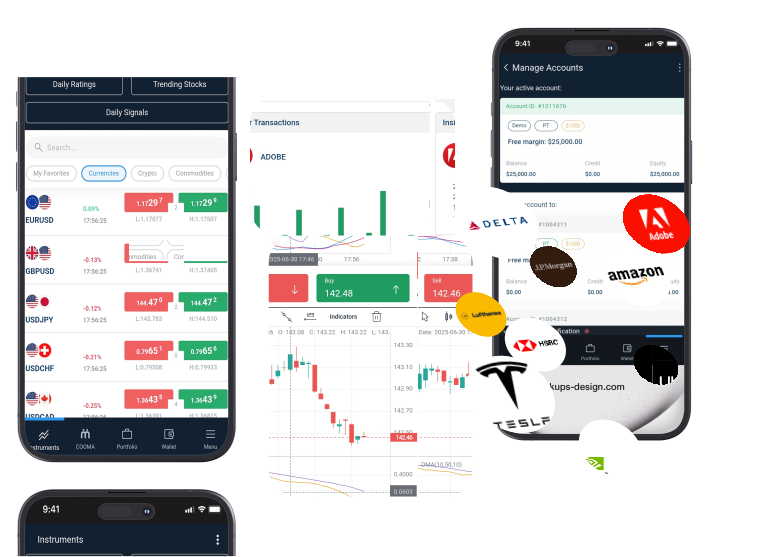
On platforms like Afaq platform, traders gain access to advanced profit calculator forex tools that integrate real-time market data, ensuring calculations reflect current conditions. These tools often include additional features such as pip value calculators, margin requirements, and even swap rate considerations for overnight positions.
Why Do Forex Traders Need a Profit Calculator?
Forex trading is a high-stakes game where even experienced traders can lose money if they don’t approach it with discipline and precision. A profit calculator forex serves as a critical decision-making aid for several reasons:
- Eliminates Human Error: Manual calculations are prone to mistakes, especially when dealing with leverage, pip values, and multiple currency pairs. A profit calculator for forex automates these processes, reducing the risk of miscalculations that could lead to unexpected losses.
- Enhances Risk Management: Traders often enter positions without fully understanding the potential downside. A profit calculator for forex allows traders to set stop-loss and take-profit levels based on their risk tolerance. For instance, if a trader risks 1% of their account per trade, the calculator can help determine the appropriate position size to maintain this risk level.
- Saves Time and Effort: Calculating profits and losses manually for every trade is time-consuming. A profit calculator for forex provides instant results, allowing traders to evaluate multiple scenarios quickly. This is particularly useful for day traders who execute dozens of trades in a single session.
- Improves Trading Psychology: Emotional decisions are the enemy of consistent trading success. By using a profit calculator for forex, traders can remove guesswork from their strategies, leading to more objective and disciplined trading. Knowing the exact profit or loss before entering a trade helps traders stick to their plans rather than deviating based on fear or greed.
- Facilitates Backtesting and Strategy Development: A profit calculator for forex can be used to test trading strategies by simulating historical price movements. Traders can input past data to see how their strategies would have performed, refining their approaches before risking real capital.
- Adapts to Different Trading Styles: Whether a trader is a scalper, swing trader, or position trader, a profit calculator for forex can be customized to fit their specific needs. For example, scalpers focusing on small, frequent trades will use different inputs compared to position traders holding trades for weeks or months.
For traders using platforms like Afaq, integrating a profit calculator into their workflow ensures they have a reliable tool to support their trading decisions. The ability to adjust variables such as leverage, lot size, and currency pairs in real time provides a dynamic advantage, allowing traders to adapt to changing market conditions with confidence.
How does a Profit Calculator Forex Work?
At its core, a profit calculator for forex operates by processing a few key inputs to generate accurate profit or loss projections. Understanding how these tools function demystifies their value and helps traders leverage them effectively. Here’s a breakdown of the mechanics:
- Inputting Trade Parameters: The calculator requires traders to input essential details about their trade, including: Currency Pair: The specific pair being traded, such as EUR/USD or GBP/JPY. Lot Size: The volume of the trade, typically measured in standard (100,000 units), mini (10,000 units), or micro (1,000 units) lots. Entry Price: The price at which the trader opens the position. Exit Price: The price at which the trader closes the position or the stop-loss and take-profit level. Leverage: The ratio of the trade size to the margin required, for example, 1:100 means $1 of margin controls $100 in the market.
- Calculating Pip Value: The profit calculator forex converts price movements into pips (percentage in points), the smallest unit of measurement in forex. For example, if EUR/USD moves from 1.1000 to 1.1050, it has moved 50 pips. The calculator then determines the monetary value of each pip based on the lot size and currency pair. For instance, in a standard lot of EUR/USD, one pip equals $10.
- Applying Leverage: Leverage amplifies both profits and losses. If a trader uses 1:100 leverage on a $1,000 account, they can control a $100,000 position. The profit calculator forex accounts for this by adjusting the potential profit or loss accordingly. For example, a 50-pip gain on a standard lot of EUR/USD with 1:100 leverage would yield $500 in profit (50 pips x $10 per pip).
- Determining Profit or Loss: The calculator subtracts the entry price from the exit price to find the total pip movement. It then multiplies this by the pip value to arrive at the profit or loss in the trader’s account currency. For instance: Profit Calculation: (Exit Price – Entry Price) x Pip Value x Lot Size = Profit Loss Calculation: (Entry Price – Exit Price) x Pip Value x Lot Size = Loss
- Incorporating Additional Factors: Advanced profit calculator forex tools may also factor in: Swap Rates: Costs or credits for holding positions overnight. Commission Fees: Charges imposed by brokers for executing trades. Margin Requirements: The minimum amount required to open a position, which varies by broker and leverage.
For traders using Afaq, the profit calculator forex tool is designed to handle these variables seamlessly, providing real-time adjustments as market conditions shift. This ensures traders have a clear picture of their potential outcomes before committing capital.
Calculating Profit and Loss in Forex Trading
Accurate profit and loss (P&L) calculations are the backbone of successful forex trading. A profit calculator for forex automates these calculations, but understanding the underlying process ensures traders can verify results and adapt their strategies. Below are the step-by-step methods for calculating P&L, along with practical examples and common pitfalls to avoid.
Step-by-Step Profit and Loss Calculation
- Determine the Pip Movement: The first step is calculating the difference between the entry and exit prices in pips. Pips are the standard unit of measurement in forex, representing the smallest price change. For most currency pairs, such as EUR/USD and GBP/USD, one pip equals 0.0001. For pairs like USD/JPY, one pip equals 0.01. Example: If you buy EUR/USD at 1.1050 and sell at 1.1100, the pip movement is 50 pips (1.1100 – 1.1050 = 0.0050).
- Calculate the Pip Value: The value of each pip depends on the lot size and the currency pair. This is where traders often make mistakes, especially when dealing with exotic pairs.
- Standard Lot (100,000 units): EUR/USD: $10 per pip GBP/USD: $10 per pip USD/JPY: $10 per pip
- Mini Lot (10,000 units): EUR/USD: $1 per pip GBP/USD: $1 per pip
- Micro Lot (1,000 units): EUR/USD: $0.10 per pip
- Apply Leverage to Adjust for Margin: Leverage changes the nominal value of the trade but does not alter the pip value calculation.
- However, it affects the actual profit or loss in the trader’s account. Example: If you use 1:50 leverage on a $1,000 margin to control a $50,000 position, a 50-pip gain on EUR/USD (standard lot) would normally be $500. Since your margin is only $1,000, your actual profit remains $500, not $500 x leverage. Leverage amplifies the position size, not the profit percentage relative to margin.
- Factor in spreads and Commissions: Brokers charge spreads (the difference between bid and ask prices) and sometimes commissions per trade. These costs reduce net profit. Example: If the spread for EUR/USD is 2 pips, and you enter a trade at 1.1050 (ask), your effective entry price is 1.1052. If you close at 1.1100, your net pip movement is 48 pips (1.1100 – 1.1052), not 50. Solution: Use a profit calculator for forex that accounts for spread to get realistic P&L estimates.
- Calculate Net Profit or Loss: Combine all factors to determine the outcome: Profit = (Exit Price – Entry Price – Spread) x Pip Value x Lot Size Loss = (Entry Price – Exit Price + Spread) x Pip Value x Lot Size
Common Mistakes in Manual P&L Calculations
Even experienced traders sometimes miscalculate profits or losses. Here are the most frequent errors and how to avoid them:
- Ignoring the Spread: Many traders forget that the bid-ask spread eats into profits. Always account for it in calculations. Fix: Use a profit calculator forex that includes spread adjustments.
- Misapplying Lot Size to Pip Value: Confusing standard, mini, and micro lots can lead to incorrect pip value assumptions. Fix: Memorize pip values for common lot sizes: Standard Lot: $10 for EUR/USD, GBP/USD, and USD/JPY Mini Lot: $1 for EUR/USD, GBP/USD, and USD/JPY Micro Lot: $0.10 for EUR/USD, GBP/USD, and USD/JPY.
- Overlooking Leverage’s Impact on Margin, Not Profit: Some traders mistakenly think leverage multiplies profit percentages, but it only affects position size. Example: A 100-pip gain on a standard lot is $1,000 profit, regardless of leverage. If you used 1:100 leverage with a $1,000 margin, your profit is still $1,000, but your return on margin is 100% ($1,000 profit / $1,000 margin).
- Forgetting About Swap Rates for Overnight Trades: Holding positions overnight incurs swap fees or credits for favorable trades. These can significantly reduce net profit. Example: If you hold a long EUR/USD trade overnight and the broker charges a 3.5-pip swap, your effective exit price is adjusted downward by 3.5 pips. Fix: Use a profit calculator for forex that includes swap rate calculations.
- Using Incorrect Base Currency for Profit: Profit is calculated in the account currency, not the traded pair. If your account is in USD but you trade EUR/JPY, the calculator must convert the profit into USD. Example: A 100-pip gain on EUR/JPY (mini lot) might be 1,000 yen profit, which then converts to approximately $8.50 USD if 1 EUR = $1.10 and 1 JPY = $0.0085.
When to Use a Profit Calculator vs. Manual Calculation?
While manual calculations help traders understand the mechanics, a profit calculator for forex is far more efficient and accurate. Here’s when each method is best:
- Quick Back-of-the-Envelope Checks: Manual Calculation Good for rough estimates.
- Profit Calculator Forex: Overkill for simple trades.
- High-Frequency Trading (Scalping): Manual Calculation Too slow and error-prone.
- Profit Calculator Forex: Instant, real-time adjustments.
- Testing Multiple Scenarios: Manual Calculation Time-consuming.
- Profit Calculator Forex: Adjust variables in seconds.
- Exotic Currency Pairs: Manual Calculation Complex conversions.
- Profit Calculator Forex: Handles pip values automatically.
- Including Spread, Swap, and Commissions: Manual Calculation: Easy to miss factors.
- Profit Calculator Forex: Accounts for all variables.
- Educational Purposes (Learning): Manual Calculation Helps understand mechanics.
- Profit Calculator Forex: Less intuitive for beginners.
- Pro Tip: For traders using Afaq, the integrated profit calculator forex tool eliminates guesswork by pulling real-time data, ensuring calculations are always up-to-date with market conditions.
Role of Pip Value in Profit Calculations
Pip value is the foundation of forex profit calculations, yet many traders misunderstand how it works, especially when switching between currency pairs or lot sizes. A profit calculator for forex simplifies this process, but grasping the concept is crucial for accurate trading decisions.
What is Pip Value?
A pip (percentage in point) is the smallest price movement in a currency pair. For most pairs, one pip equals 0.0001, while for JPY pairs, one pip equals 0.01. The monetary value of each pip depends on the lot size and the currency pair being traded. Understanding pip value is essential for calculating potential profits and losses accurately, and it forms the core input of any reliable profit calculator forex tool.
How Pip Value Impacts Trading Decisions?
Pip value directly affects risk management, position sizing, and expected returns. A trader targeting 50 pips on a position with a $10 pip value could potentially gain or lose $500 depending on market direction. This makes pip value one of the most important variables when planning a trade. By using a profit calculator for forex, traders can estimate outcomes before entering positions, helping them align their trades with their risk tolerance and account size.
Factors That Influence Pip Value
Several factors determine pip value in forex trading:
- Currency Pair: Major pairs and JPY pairs have different pip calculations.
- Lot Size: Larger positions increase the value of each pip movement.
- Exchange Rate: Pip value may fluctuate depending on the account’s base currency.
- Market Volatility: Rapid price changes can amplify gains or losses associated with pip movements.
FAQs
Are forex profit calculators accurate for real trading?
Forex profit calculators provide accurate estimates based on current market prices, lot sizes, and pip values entered by the trader. However, actual trading results may vary due to spreads, slippage, commissions, and market volatility during execution. This is why traders use calculators as guidance tools rather than guaranteed profit predictors.
How do leverage and margin impact profit calculations?
Leverage increases the size of a trading position using a smaller amount of capital, which can magnify both profits and losses. Margin represents the required funds needed to open and maintain a leveraged trade in the forex market. Understanding both factors is essential because they directly influence risk exposure and potential returns on every transaction.
What are the best tools for calculating forex profits?
Many traders use built-in broker calculators, MetaTrader tools, and online forex profit calculators to estimate potential gains and losses. These tools help calculate pip value, margin requirements, leverage effects, and projected profit outcomes before entering trades. Using reliable calculation tools improves risk management and supports more informed trading decisions.